

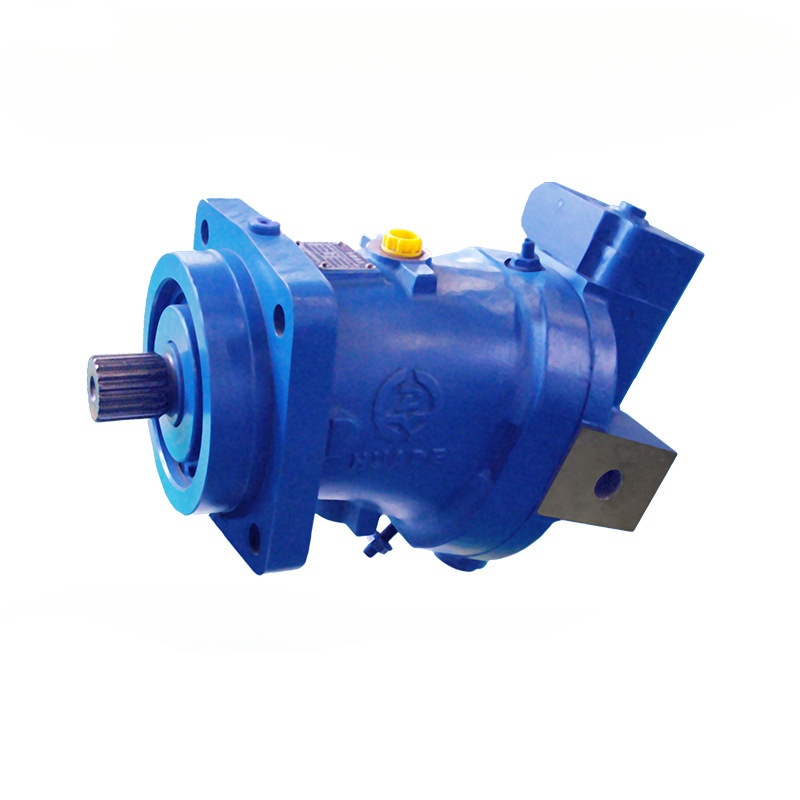



If you are designing a high-pressure hydraulic system, you eventually face a choice: Gear, Vane, or Piston? For applications requiring high pressure (above 250 bar), variable flow control, and high efficiency, the In-Line Axial Piston Pump (often called a Swashplate Pump) is the industry standard. It powers everything from the excavator digging a foundation to the injection molding machine making plastic parts.
This guide breaks down the mechanics, the critical difference between "In-Line" and "Bent Axis," and how to specify the right pump for your circuit.
How It Works: The "Swashplate" Mechanism
The defining feature of an in-line pump is that the drive shaft and the cylinder block share the same axis. So, how do the pistons move in and out?
The Core ConceptInside the pump, a cylinder block containing multiple pistons (usually 9) rotates with the drive shaft. The ends of these pistons rest on a stationary, angled surface called the Swashplate.
- Intake (Suction): As the cylinder block rotates, pistons slide down the swashplate slope, pulling out of bores. This vacuum sucks oil in through the port plate.
- Discharge (Pressure): As rotation continues, pistons ride up the slope, pushing back into bores. This compresses oil and forces it out the discharge port.
The true power lies in control. By changing the swashplate angle, you change the piston stroke.
- Steep Angle: Long stroke = Maximum Flow.
- Flat Angle (0°): No stroke = Zero Flow (Idling).
- Reverse Angle: Flow direction reverses (for closed-loop drives).
In-Line vs. Bent Axis Pumps: Which One Do You Need?
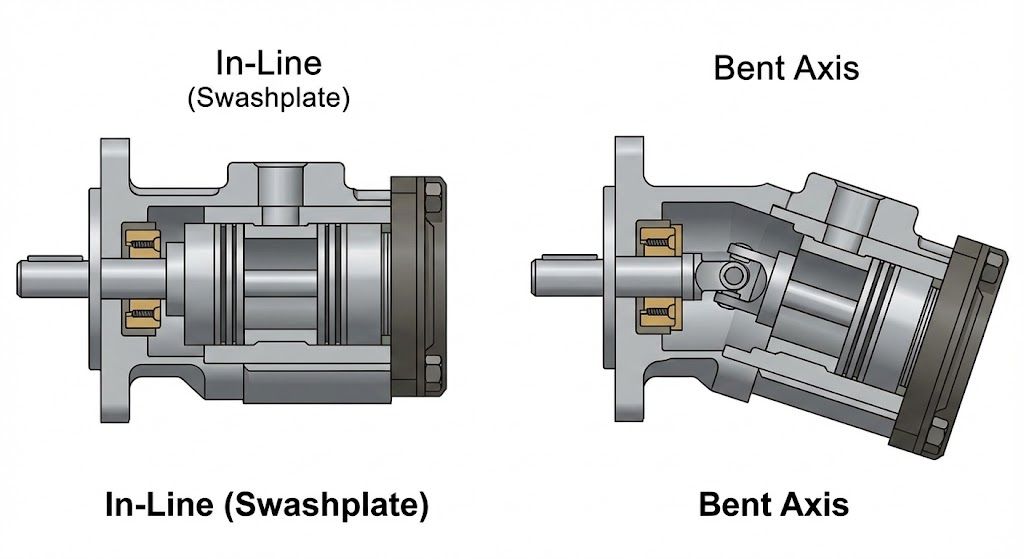
This is the most common confusion point. Both are "Axial Piston Pumps," but they are built differently for different jobs.
| Feature | In-Line (Swashplate) | Bent Axis |
|---|---|---|
| Geometry | Shaft and pistons are straight (in-line). | Cylinder block bent at angle (25°-40°). |
| Cost | Lower (easier to manufacture). | Higher (complex synchronization). |
| Efficiency | Good (~90-95%). | Superior (~97-98%). |
| Max Speed | Moderate (swashplate friction). | High (runs at very high RPMs). |
| Control | Excellent (Through-drive capable). | Harder to package (usually single-unit). |
| Best For... | General Industrial & Mobile. | Heavy Duty Mobile (High torque). |
Choose In-Line for versatility, compact installation, and standard high-pressure applications.
Choose Bent Axis only if you need extreme efficiency or ruggedness in harsh environments.
Control Options: Making the Pump "Smart"
You don't just buy a pump; you buy a control strategy. The swashplate is moved by a control piston commanded by:
- Pressure Compensator (DR): The "Safety Valve" mode. Maintains full flow until set pressure is reached, then destrocates to zero flow. Saves energy.
- Load Sensing (DFR): The "Fuel Saver." Monitors actuator pressure and delivers only required pressure + margin (e.g., 20 bar). Standard on excavators.
- Horsepower Limiting (LR): Protects the engine. Reduces flow as pressure rises to keep Torque × Speed below engine stalling point.
Key Specifications for Selection
When looking at a datasheet (like Rexroth A10VSO or Parker P1), focus on these three numbers:
- Displacement (cc/rev): How much oil moves per rotation? (Common: 18, 45, 71, 100 cc).
- Nominal Pressure (\( p_{nom} \)): The pressure it can run at 24/7 (Usually 280 bar).
- Peak Pressure (\( p_{max} \)): The brief spike it can survive (Usually 350 bar).
Never spec a pump exactly at its peak pressure. If your system runs at 300 bar constantly, buy a heavy-duty pump rated for 350 bar nominal, not a standard pump rated for 280 bar.
Troubleshooting: The "Case Drain" Tell
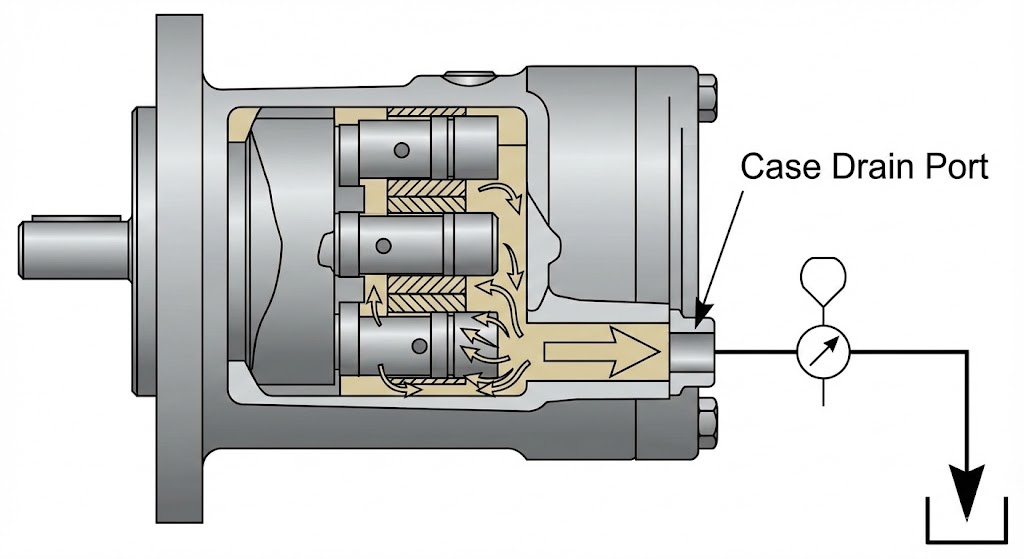
In-line piston pumps have a dedicated port called the Case Drain. Because pistons always leak slightly for lubrication, this oil must return to the tank.
Symptom: Pump is noisy or overheating.
Check: Pull the case drain hose and measure flow.
Verdict: If a massive amount of oil is gushing out, the slipper pads or cylinder barrel are worn out. The pump is bypassing internally and needs a rebuild.
Ready to specify? Whether replacing a worn unit or designing a new HPU, we can help. Need a replacement? Send us the model code (e.g., A10VSO 71 DFR1...). Starting from scratch? Tell us your required Flow (L/min) and System Pressure (Bar).