




I’ve spent two decades troubleshooting hydraulic systems, and I’ve seen countless engineers make the same mistake: they buy an expensive axial piston pump when a cheap gear pump would have done the job, or—worse—they try to push a gear pump into a high-pressure cycle and end up with a pile of melted scrap metal. Choosing the right pump isn't just about "spending more money." It’s about matching the physics of your application to the mechanical limits of the hardware.

When Pressure Hits the Ceiling (> 250 Bar)
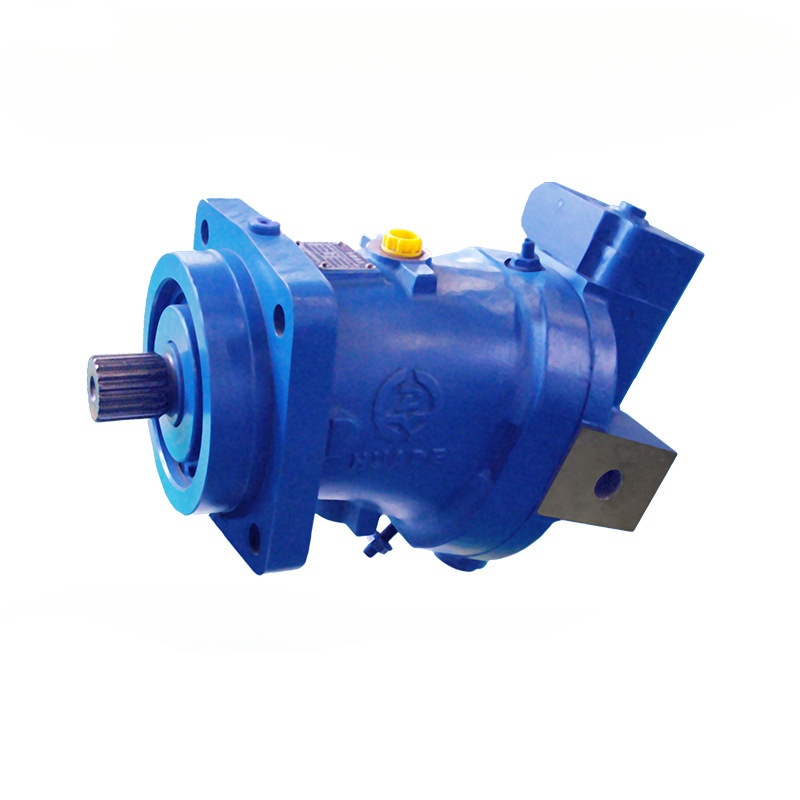
If your system needs to operate consistently above 250 bar (3600 psi), the debate is over. You need an axial piston pump. While some high-pressure gear pumps claim they can hit these numbers, they often do so at the cost of a massive drop in volumetric efficiency and a very short service life.
Axial piston pumps are the "muscle" of the hydraulic world. Because they use a hydrostatic balancing design—where a thin film of oil (often only 5-10 microns thick) supports the internal moving parts—they can handle continuous pressures of 350-450 bar without metal-to-metal contact. If you are building an excavator, a heavy press, or a high-torque winch, this is your only reliable option.
The "Variable" Secret: Why Piston Pumps Save You Money
The biggest reason I recommend these pumps isn't just the pressure; it's the variable displacement. In a fixed-pump system, any oil you don't use gets dumped over a relief valve. That is pure wasted energy turned into heat.
- Load Sensing (LS): The pump "feels" the load and only provides exactly the flow and pressure needed.
- Pressure Compensation: When the cylinder reaches the end of its stroke, the pump "destrokes" to near-zero flow but maintains full pressure.
- Energy Efficiency: You stop paying to heat up your hydraulic oil. In a 100kW system, switching to a variable piston pump can often pay for itself in energy savings within 12 months.
The flow (\( Q \)) is calculated by:
$$ Q = \frac{V_g \cdot n \cdot \eta_v}{1000} $$By dynamically changing \( V_g \) (displacement) while your motor speed (\( n \)) stays constant, you gain total control over your system's power output.
Choosing Your Weapon: Swash Plate vs. Bent Axis
Not all piston pumps are born equal. You have to decide between the two main architectures based on your space and power needs.
- Swash Plate: These are compact and allow for Through-drive. This means you can "stack" another pump (like a small gear pump for cooling) right onto the back of the main shaft. They are the standard for mobile machinery.
- Bent Axis: These are the tanks. Because they don't have a slipper-pad-on-swash-plate friction point, they have higher mechanical efficiency and better self-priming capabilities. They are perfect for heavy-duty winches or high-speed motors.
Comparison of Hydraulic Pump Types
To help you decide, I’ve mapped out how the axial piston pump stacks up against its cousins.
| Feature | Gear Pump | Vane Pump | Axial Piston Pump |
|---|---|---|---|
| Max Pressure | 210 - 250 bar | 175 - 210 bar | 350 - 450+ bar |
| Control | Fixed Only | Some Variable | Fully Variable / Intelligent |
| Efficiency (\( \eta_v \)) | 80% - 90% | 85% - 92% | 92% - 98% |
| Contamination Tolerance | High (Rugged) | Medium | Very Low (Requires fine filtering) |
| Typical Cost | $ | $$ | $$$ |
The Real-World "Must-Have" Scenarios
- Closed-Loop Traction Drives: If you are driving the tracks of a 20-ton excavator. You need the ability to reverse flow and change speed instantly without massive valves.
- High-Pressure Industrial Presses: Where you need to hold 350 bar for long periods during a "cure" cycle without boiling your oil.
- Aerospace & High-Performance Mobile: When every kilogram of weight matters. Piston pumps offer the highest power-to-weight ratio in the industry.
The Catch: Why You Might NOT Want a Piston Pump
I’m an engineer, not a salesman. I’ll be honest: axial piston pumps are "divas." If you don't treat them right, they will fail fast and expensive.
- The Cleanliness Tax: You cannot run these pumps on dirty oil. While a gear pump might survive ISO 20/18/15 oil, a piston pump demands ISO 4406 18/16/13 or better (NAS 7-8). If you don't have a high-quality, 10-micron absolute filter, don't buy a piston pump.
- Inlet Conditions (NPSH): Piston pumps hate a vacuum. If your suction line is too long or restricted, you will get Cavitation. This sounds like marbles in a blender and will eat your valve plate for breakfast.
- The Cost: If your system runs at 100 bar and stays at a constant speed, buying a piston pump is a waste of your company's money. Stick to a vane or gear pump.
Would you like me to help you calculate the specific return on investment (ROI) for switching your current system to a variable axial piston pump?