

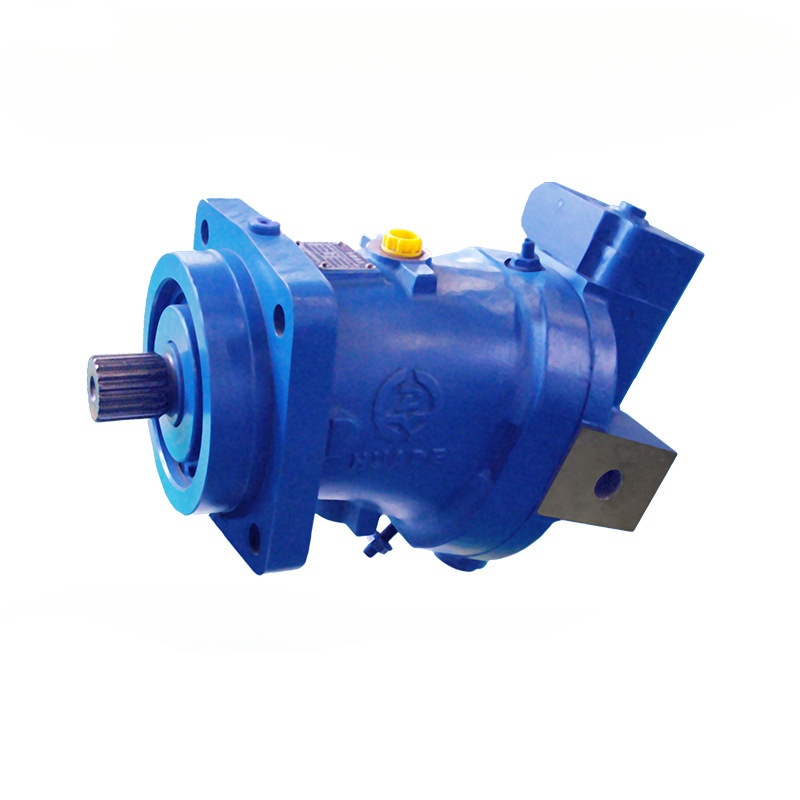



If you’ve spent any time maintaining heavy machinery, you know that an axial piston pump is the most expensive "heart" in your hydraulic system. I’ve seen these pumps torn apart after only 500 hours because someone grabbed a bucket of cheap oil. For a pump that runs at 350 bar with internal clearances smaller than a human hair, the oil isn't just a lubricant—it’s a critical structural component. If the "blood" is wrong, the heart fails.
Why Your Pump is So Picky about Fluid (The 1-Micron Rule)
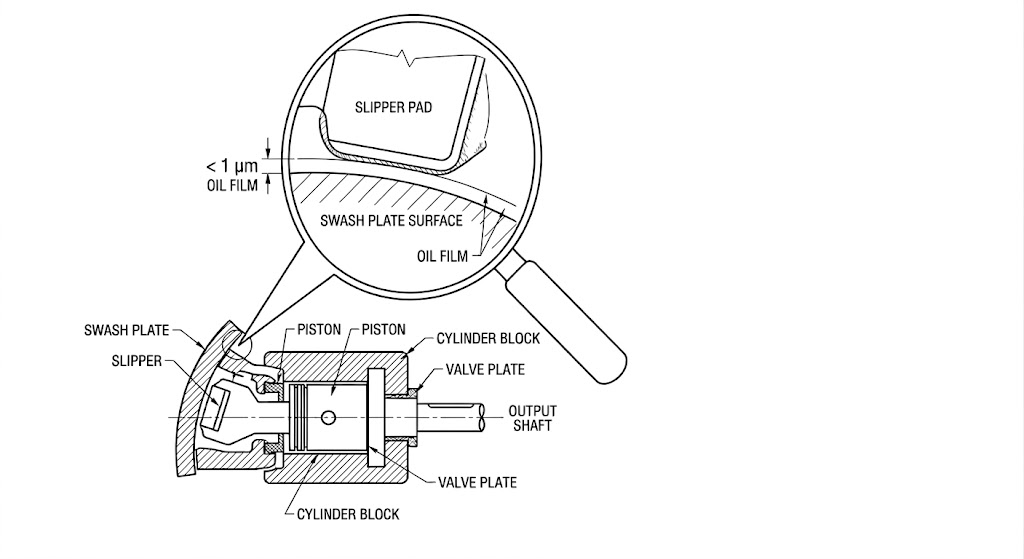
Inside your pump, there are three main friction points: the slipper to swash plate, the piston to cylinder bore, and the cylinder block to valve plate. In these areas, the oil must form a film that is often less than \( 1\mu m \) thick.
If your oil is too thin, that film snaps. You get metal-on-metal contact, also known as Scuffing or Galling, and your pump essentially welds itself to death. If it’s too thick, the pump can’t "breathe," leading to Cavitation—where vacuum bubbles implode and eat away at your metal surfaces. You need a fluid that stays in the "sweet spot" of viscosity to balance Volumetric Efficiency (\( \eta_{vol} \)) and Mechanical Efficiency (\( \eta_{hm} \)).
The Soul of Hydraulic Fluid: Viscosity Selection
Viscosity is the most important number on the bucket. But don't just look at the ISO VG rating at 40°C. You need to know how that oil behaves at your actual operating temperature.
Most manufacturers, like Bosch Rexroth or Danfoss, want your oil to stay between 16 cSt and 36 cSt during normal operation. If you drop below 10 cSt, you are in the danger zone for high-pressure internal leakage.
| Environment Type | Recommended ISO VG | Typical Temp Range | Engineering Priority |
|---|---|---|---|
| Extreme Cold / Arctic | ISO VG 22 / 32 | -20°C to +30°C | Low-temp fluidity to prevent cavitation |
| Standard Industrial (Indoor) | ISO VG 46 | 0°C to +60°C | Balanced efficiency and film strength |
| High Heat / Tropical | ISO VG 68 / 100 | +20°C to +90°C | High-temp film thickness to prevent scuffing |
The Additive Debate: Zinc-Based vs. Ashless
When the oil film breaks under a shock load, you rely on Anti-Wear (AW) additives. Historically, we used ZDDP (Zinc). It’s cheap and creates a sacrificial "glassy" layer on steel parts. However, I’m seeing more engineers switch to Ashless (Zinc-Free) oils for two reasons:
- Yellow Metal Protection: Zinc can be aggressive toward the bronze slippers in older pumps if moisture gets in.
- Filterability: Zinc can create "sludge" that plugs up the fine 3-micron or 10-micron filters used in modern systems.
Pro Tip: Never mix these two!
If you pour Zinc-based oil into a system running Ashless fluid, they can react and create a white, jelly-like goo that will kill your pump faster than dirt ever could.
Protecting Your Investment: Cleanliness Standards
You can buy the best synthetic PAO oil in the world, but if it's dirty, it's just expensive liquid sandpaper. Axial piston pumps are incredibly sensitive to Silt Erosion. According to ISO 4406, you should aim for a cleanliness level of 18/16/13:
- 18: 1,300 to 2,500 particles (>4μm)
- 16: 320 to 640 particles (>6μm)
- 13: 40 to 80 particles (>14μm)
Most "new" oil from the barrel is actually around 22/20/17, which is far too dirty for a high-pressure piston pump. Always use a filter cart to pump new oil into your reservoir.
Trust Anchors: Look for the Certification
If you want the best for your equipment, don't just look for "Hydraulic Oil" on the label. Look for these specific ratings:
- Bosch Rexroth RDE 90235: The toughest test in the industry. It involves running a pump at 500 bar for 500 hours.
- Parker Hannifin HF-0: A high-level standard for both piston and vane pumps.
- DIN 51524 Part 3 (HVLP): Ensures the oil has a high Viscosity Index and won't thin out when it gets hot.
Summary Checklist for Your Next Oil Change
- Check the Manual: Ensure the fluid meets your OEM’s specific rating (e.g., Rexroth 90220).
- Match the Temp: Use VG 46 for most uses, but go to VG 68 if you’re in a hot climate.
- Test the Oil: Don't guess. Send an oil sample for MPC (Varnish) testing every 500 to 1,000 hours.
- Filter Everything: Use a high-efficiency filter with a Beta Ratio (\( \beta_x \)) of 1000.
Would you like me to analyze a specific oil brand’s data sheet for you, or perhaps help you troubleshoot a pump that is running too hot?