

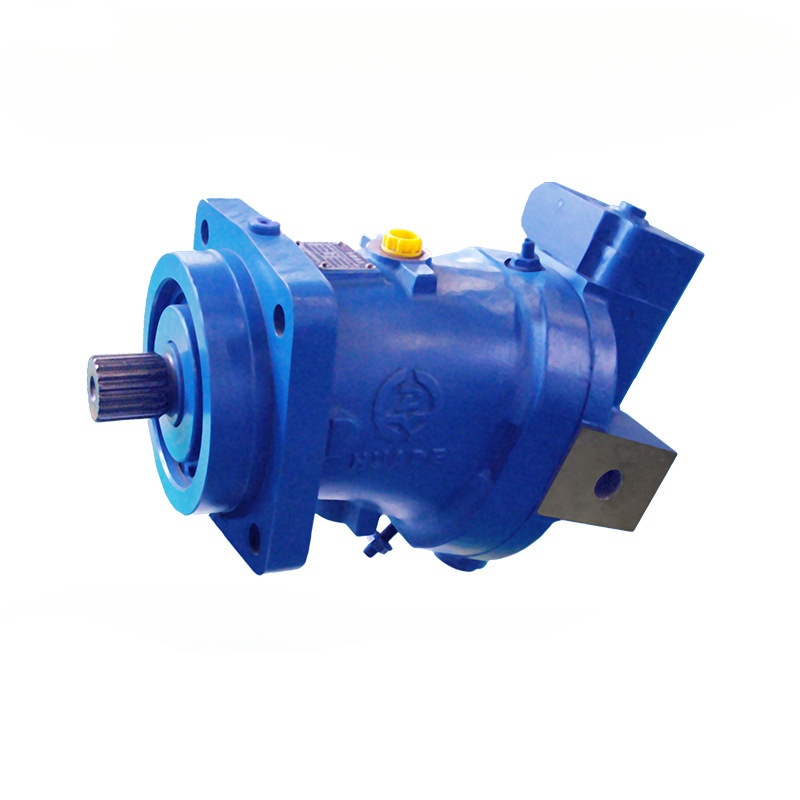



In the world of hydraulic power, the Axial Piston Pump is the "heart" of the system. While variable displacement pumps often get the spotlight for their control capabilities, the Fixed Displacement Axial Piston Pump remains the industry standard for high-pressure, heavy-duty reliability.
Why choose a pump that you can't adjust? Because simplicity equals durability. In applications ranging from deep-sea ROVs to high-speed saw motors, the fixed piston pump offers unmatched power density and efficiency. This white paper dissects the technology from the inside out, compares rival architectures, and provides a field guide for troubleshooting.
The Physics: How It Generates Flow

Unlike a gear pump that carries oil around the outside of gears, a piston pump works on the principle of Reciprocating Positive Displacement. Inside the pump housing, a Cylinder Block (Barrel) containing an odd number of pistons rotates, forcing pistons to slide in and out of their bores.
- Suction Stroke: As the piston pulls out, it creates a vacuum, drawing oil in through the kidney-shaped suction port.
- Discharge Stroke: As the piston pushes back in, it squeezes oil out through the pressure port.
In a fixed pump, the Swash Plate angle is locked permanently. The volume of oil displaced per revolution ($cc/rev$) is constant. To change the flow rate ($Q$), you must change the drive speed ($n$) of the motor.
$$ Q (L/min) = \frac{Displacement (cc/rev) \times RPM}{1000} $$Because there are no control servos or feedback linkages to fail, fixed pumps have a significantly higher Mean Time Between Failures (MTBF) than variable pumps, especially in harsh vibration environments.
Design Battle: Swash Plate vs. Bent Axis
Not all fixed pumps are created equal. You will encounter two distinct architectures in the market. Knowing the difference is critical for selection.
| Feature | Type A: In-Line Swash Plate | Type B: Bent Axis |
|---|---|---|
| Structure | Cylinder block aligned with shaft. Pistons ride on angled plate. | Cylinder block angled relative to shaft (banana shape). |
| Key Advantage | Through-Drive Capability: Can mount auxiliary pumps on back. | Efficiency King: No sliding friction on swash plate (>95% eff). |
| Pros | Compact, lower cost, tandem mounting. | Higher pressure (450 bar), self-priming, robust. |
| Cons | Lower efficiency (side loads), limited to ~350 bar. | Bulky shape, no through-drive option. |
| Typical Series | Rexroth A2FO (10-16), Vickers PVB. | Rexroth A2FO (23+), Parker F11/F12. |
Circuit Integration & Servo Applications
How do you use a fixed pump if you can't change its displacement?
Traditional Open LoopIn standard systems, the pump runs at constant speed. Excess flow is dumped over a relief valve. This is simple but energy-inefficient.
The Modern Solution: Servo-Pump DriveThis is the current trend in injection molding and press brakes. A fixed axial piston pump is coupled to a high-dynamic Servo Motor. Instead of using a valve to throttle flow, the controller changes the motor speed in milliseconds.
- Need high flow? Motor runs at 3000 RPM.
- Need to hold pressure? Motor crawls at 50 RPM.
Troubleshooting: Reading the "Corpse"
When a piston pump fails, the internal damage tells a story.
| Symptom | Sound / ID | Root Cause & Fix |
|---|---|---|
| Cavitation | Loud crackling ("Marbles"). Pitting on valve plate. | Restricted Inlet. Pump starving for oil. Check suction strainers and hoses. |
| Aeration | High-pitched whine. Foamy oil. | Air Ingress. Loose suction fitting or low tank level. |
| Case Explosion | Catastrophic seal blowout or cracked housing. | Blocked Case Drain. Leakage oil must return to tank freely. Never filter the drain line under pressure. |
Summary & Selection Guide
| Requirement | Recommended Design | Why? |
|---|---|---|
| Space is tight / Tandem mounting | Swash Plate (In-Line) | Straight profile allows stacking pumps. |
| Pressure > 400 bar / Harsh duty | Bent Axis | Superior bearing load capacity and efficiency. |
| Servo-Drive Application | Fixed Piston (High Speed) | Low inertia and high volumetric efficiency. |
When ordering a replacement, never guess. A "Rexroth A2FO" comes in dozens of variations (Shaft type, Flange type, Seal material). Always locate the Nameplate and search by the full alphanumeric code (e.g., A2FO 32/61R-VPB05).