




Is your dashboard suddenly lit up with a Check Engine Light? Does your car feel like it has a mind of its own—revving high at stoplights or refusing to accelerate when you merge onto the highway? All signs point to one critical component: The Throttle Valve Position Sensor (TPS).
To most drivers, it looks like a cheap piece of black plastic. But to your car's brain (the ECU), the TPS is its "eyes." It tells the computer exactly how deep your foot is on the pedal. If this sensor starts "lying" or goes silent, your engine, transmission, and fuel economy will instantly suffer.
This isn't just a definition guide. This is your troubleshooting handbook. We will cover what the symptoms look like, how to decode those P0121 errors, and the "Relearn" trick that most mechanics charge you $100 to do.
The Symptoms: How to Know It’s the TPS?
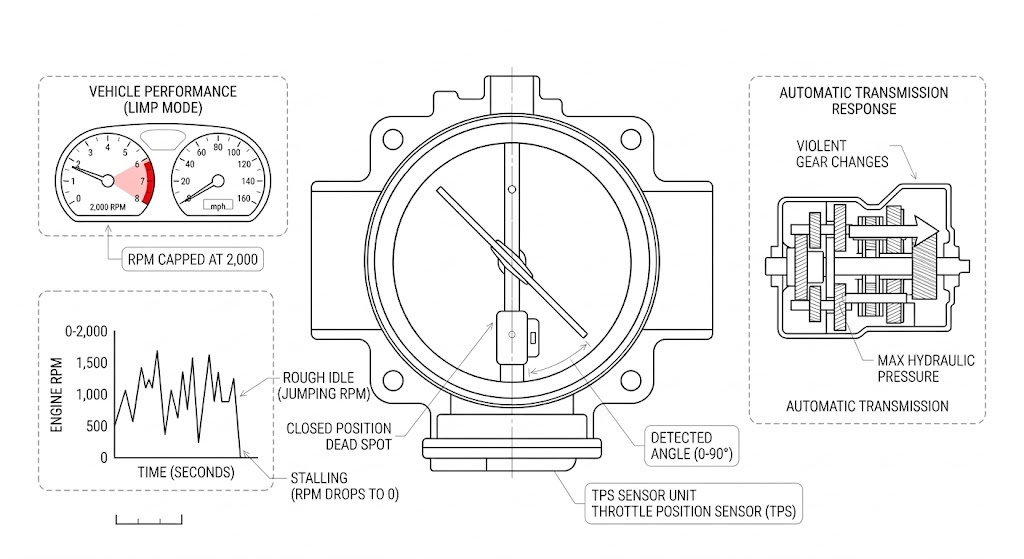
When throttle position data goes bad, the symptoms are rarely subtle. If you are experiencing any of these three scenarios, stop guessing and start testing.
- "Limp Mode" (The Safety Net): This is the most common sign. You press the gas, but the RPMs won't go past 2,000, and speed is capped at 40 mph. The ECU is limiting power to prevent engine damage.
- Rough Idle or Stalling: The needle jumps wildly between 500 and 1,500 RPM, or the engine dies the moment you coast. This suggests a sensor "dead spot" at the closed position.
- Transmission "Slam" Shifting: Your automatic transmission needs throttle data to shift smoothly. Without it, the transmission maxes out hydraulic pressure, resulting in violent gear changes that feel like a collision.
Decoding the Error Codes (DTCs)
Plug in your OBD-II scanner. Here is the plain-English translation of what is actually happening under the hood.
| DTC Code | Technical Name | What It Actually Means |
|---|---|---|
| P0121 | TPS Range/Performance | Logic Conflict. The ECU sees high airflow (MAF) but the TPS claims the throttle is closed. |
| P0122 | TPS Circuit Low Input | Dead Signal. Voltage dropped below 0.17V. Usually a loose plug or cut wire. |
| P0123 | TPS Circuit High Input | Short to Power. Signal stuck at 5V. Often implies a snapped ground wire. |
| P2135 | Pedal/Throttle Correlation | Sensor Conflict. Electronic throttles have two internal sensors. This code means Sensor A and Sensor B disagree. |
The Multimeter Test: Diagnosis in 5 Minutes
Before buying a new part, confirm the failure using a basic digital multimeter.
- The Setup: Locate the TPS. Set multimeter to DC Volts (20V). Turn ignition ON (Engine OFF).
- Find Signal Wire: Back-probe the middle wire. Connect black probe to battery negative. Expect ~0.5V to 0.9V at closed throttle.
- The Sweep: Manually open the throttle valve extremely slowly.
- The Verdict: Watch the voltage. It should climb smoothly to ~4.5V. Any jumps to 0V or "OL" indicate a failed sensor.
Clean vs. Replace: Do You Really Need a New Part?
Sometimes, the sensor is fine, but the environment is dirty. If you have code P0121 and a rough idle, inspect the throttle plate. A ring of black, sticky carbon (coking) can prevent the valve from closing fully.
The Critical Final Step: The Idle Relearn
This is where 90% of DIYers fail. If your idle is stuck high after a repair, the ECU is still using old data. You must force a reset.
The "Battery Reset" Method (Cable Throttles):- Disconnect negative battery terminal for 15 minutes.
- Reconnect power. Turn key to ON for 10 seconds.
- Start engine. Do not touch gas pedal. Idle for 10 minutes.
- Turn on A/C (add load) and idle for another 10 minutes.
For many newer cars (Nissan, Toyota, VW) with Electronic Throttle Control, unplugging the battery won't work. You will likely need a bi-directional scan tool to perform a software "Throttle Body Alignment."
Summary
Throttle valve position issues can feel catastrophic, but the logic is simple: it is just a voltage divider reporting an angle.
If you have confirmed the TPS is working perfectly (smooth voltage sweep) and the throttle body is clean, but the car still hesitates? Check your Mass Air Flow (MAF) sensor. MAF failure symptoms often mimic TPS failures almost exactly.