If you want to control the speed of a hydraulic cylinder or motor, you can’t just “install a flow control valve.” Where you place that valve in the circuit changes everything. It determines whether your load will move smoothly, whether it can hold back gravity, and how much heat your system generates.
For complete selection guidelines and cross-reference documentation on this product line, please consult our proportional flow control valve alternatives.
There are three standard methods for applying flow control valves. Here is the engineering breakdown of Meter-In, Meter-Out, and Bleed-Off circuits.
1. Meter-In Circuit (Controlling the Supply)
In a Meter-In circuit, the flow control valve is placed in the supply line leading to the actuator. You are restricting the amount of oil entering the cylinder to slow it down.
- How it works: You restrict the inlet flow. The excess flow from the pump is forced over the system relief valve and back to the tank.
- Best For: Resistive Loads (Positive Loads). This is where the load opposes the motion, like pushing a heavy object across a floor or lifting a weight.
It cannot control negative loads. If gravity pulls the load down faster than the oil enters, you will create a vacuum in the cylinder (Cavitation), and the load will crash.
In a Meter-In circuit, the pump must always work at the relief valve setting, which generates significant heat.
2. Meter-Out Circuit (Controlling the Exhaust)
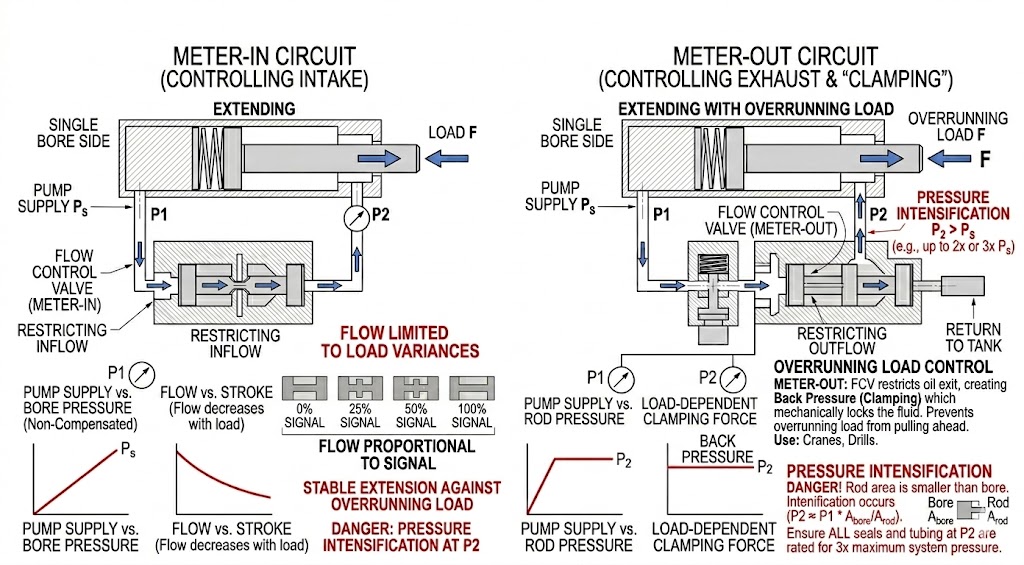
In a Meter-Out circuit, the flow control valve is placed in the return line coming out of the actuator. You are restricting the oil leaving the cylinder.
- How it works: The valve creates Back Pressure. The cylinder is effectively “clamped” between the pump pressure pushing it and the valve restricting its exit.
- Best For: Overrunning Loads (Negative Loads). If you are lowering a crane or drilling through a workpiece, Meter-Out prevents the load from pulling itself ahead by mechanically locking the fluid exit.
On the rod side of a cylinder, the pressure can multiply to dangerous levels (often 2x or 3x system pressure) because of the area difference between the bore and the rod. Ensure your seals and tubing are rated for this!
3. Bleed-Off Circuit (Bypass Control)
In a Bleed-Off (or Bypass) circuit, the flow control valve is installed on a tee line that diverts flow directly back to the tank before it reaches the actuator.
- How it works: It acts like a dimmer switch. If the pump produces 10 GPM and you bleed off 3 GPM back to the tank, the cylinder gets the remaining 7 GPM.
- Best For: Efficiency & Heat Reduction. The pump pressure only needs to be high enough to move the load, not forced up to the relief valve setting.
Major Flaw: Poor Speed Accuracy. Since flow takes the path of least resistance, if the load gets heavier, more oil will take the “easy path” through the bleed-off valve, and the cylinder will slow down.
Summary Comparison Table
| Feature | Meter-In | Meter-Out | Bleed-Off |
|---|---|---|---|
| Valve Position | Inlet (Supply Line) | Outlet (Return Line) | Bypass (Tee Line) |
| Control Logic | Restricts input | Restricts output (Back Pressure) | Diverts excess flow |
| Best Application | Opposing/Resistive Loads | Runaway/Overrunning Loads | Constant Loads / High Efficiency |
| Cavitation Risk | High (with negative loads) | None (Pressurized) | High (with negative loads) |
| Efficiency | Low (Heat Generation) | Low (Heat Generation) | High (Energy Saving) |
Which one should you choose?
- Drilling/Milling Machine? Use Meter-Out to prevent the drill from grabbing and lunging forward.
- Hydraulic Press? Use Meter-In for smooth pressure buildup on resistive loads.
- Conveyor Belt? Use Bleed-Off for softer starts and maximum energy savings.