




You pull up to a stoplight. You foot is on the brake. Suddenly, the RPM needle starts dancing, the car shudders like it’s about to die, and maybe it actually does. Panic sets in. Is it the transmission? The engine?
Before you call a tow truck, take a deep breath. In my 20 years of diagnosing engine faults, I’ve seen this exact scenario thousands of times. It is often not a catastrophic engine failure. It is usually just a dirty Throttle Body Valve. Think of your engine as an air pump. If the throttle body is the "nose" of the car, right now, it has a bad cold.
What Does a Throttle Body Valve Actually Do?
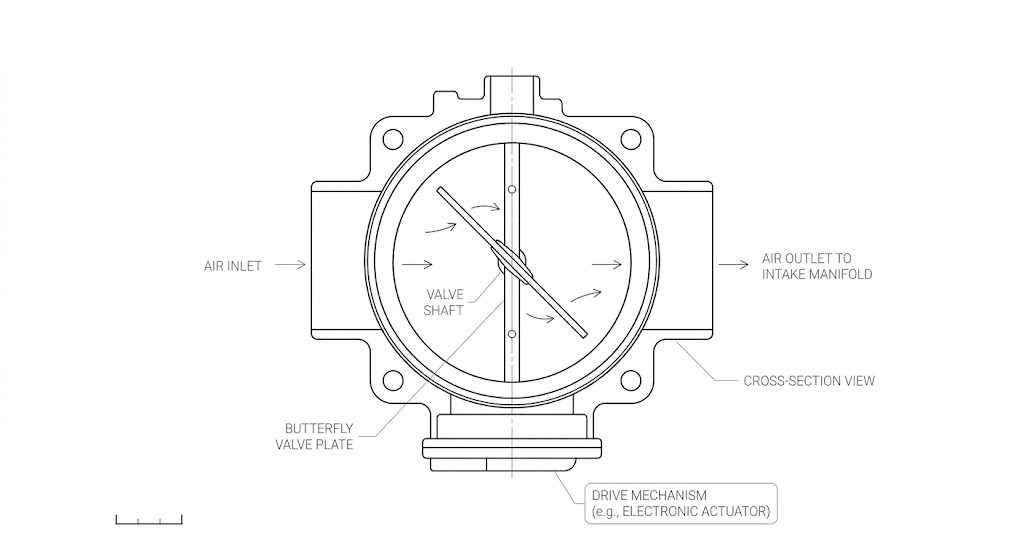
Simple explanation: It is the gatekeeper of air.
When you step on the gas pedal, you aren't actually feeding the engine gas. You are feeding it air. The throttle body contains a butterfly valve (a metal flap) that pivots open to let air into the intake manifold. The computer (ECU) detects this airflow and injects the matching amount of fuel to maintain the perfect combustion ratio.
In modern cars (pretty much anything built after 2005), there is no physical cable connecting your pedal to the engine. It’s all electronic—known as Drive-by-Wire (DBW). An electric motor opens that flap with distinct precision.
The "Cheat Sheet": Is Your Throttle Body Failing?
Google loves clear answers, so here is a breakdown of the symptoms. If you are experiencing 2 or more of these, your throttle body is the prime suspect.
| Symptom | What it Feels Like | The Engineering Reason |
|---|---|---|
| Rough Idle | Vibrations/shakes. RPM fluctuating (e.g., 500-900). | Airflow Turbulence. Carbon deposits disturb smooth airflow through the idle gap. |
| Stalling | Engine dies at sudden stops. | Air Starvation. Valve snaps shut too tightly due to sludge. |
| Sluggish Acceleration | Hesitation or stumble when speeding up. | Mechanical Lag. Motor fights sticky gum/varnish to open flap. |
| Check Engine Light | Codes: P0121, P0507, P2135. | Sensor Mismatch. Flap angle doesn't match airflow data. |
| "Limp Mode" | Speed limited to 20mph. | Safety Protocol. ECU limits power to prevent unintended acceleration. |
The Root Cause: Why Do They Get Dirty?
You might ask, "I change my air filter regularly. How did dirt get in there?" It’s not dust from the outside; it’s oil from the inside.
Engines recycle exhaust gases and crankcase vapors (via the PCV system) back into the intake to burn them off. These hot, oily vapors hit the metal throttle plate, cool down, and harden. Over 30,000 to 50,000 miles, this builds up a ridge of black sludge—technically called "Coking." This sludge disrupts the precise gap required for the engine to idle.
The $10 Fix: How to Clean a Throttle Body
Before you spend $300-$600 on a new part, try cleaning it. 80% of the time, this solves the problem.
Do NOT use standard Carburetor Cleaner. It is too harsh. Modern throttle bodies have a special coating (often Molybdenum) to seal the gap. Harsh solvents eat this coating. Only buy a can labeled "Throttle Body Cleaner."
- Access It: Pop the hood. Follow the large plastic tube coming from your air filter box. Where that tube meets the engine metal, that’s your throttle body.
- Inspect: Look inside for a black ring of soot around the butterfly flap.
- The "Brick" Method: Turn ignition to "ON" (Do NOT start). Have a friend floor the gas pedal to open the flap. (Pro Tip: Do not push it open with fingers; you can strip internal plastic gears).
- Spray and Wipe: Spray cleaner onto a rag. Wipe the bore and flap edges until shiny metal appears.
The "Hidden" Step: The Idle Relearn
After cleaning, the idle might jump (e.g., 2000 RPM). This is because the car’s computer had "learned" to open the valve wider to compensate for dirt. Now that the dirt is gone, it lets in too much air.
The Fix:
- Most Cars: Disconnect battery negative terminal for 15 minutes to reset memory.
- Nissan/Toyota/GM: May require a specific "pedal dance" or drive cycle. Check forums for your specific model.
When Should You Replace It?
Cleaning doesn't fix everything. Replace the unit if:
- Electronic Failure: Electrical codes like P2135 (Sensor Voltage Correlation). Sensors are usually non-serviceable.
- Gear Stripping: A "clicking" or "grinding" noise from the valve when key is turned ON.
- High Mileage: Internal shaft wear causes air leaks that cleaning cannot seal.
A rough idle isn't a death sentence for your car. It is often just a cry for hygiene. Diagnosis: Check for rough idle. First Action: Clean with specific Throttle Body Cleaner. Second Action: Reset the ECU. Last Resort: Replace.