




If you are designing a hydraulic system that requires more than just "Stop" and "Go," you are likely looking at Proportional Flow Control Valves. Unlike standard solenoid valves that are either 100% open or 100% closed, proportional valves allow you to throttle fluid flow infinitely between 0 and maximum. This gives you precise control over the speed and acceleration of hydraulic cylinders and motors.
Whether you are retrofitting an injection molding machine or designing a new mobile crane, this guide explains the working principles, key specs, and how to choose the right valve for your application.
What is a Proportional Flow Control Valve?

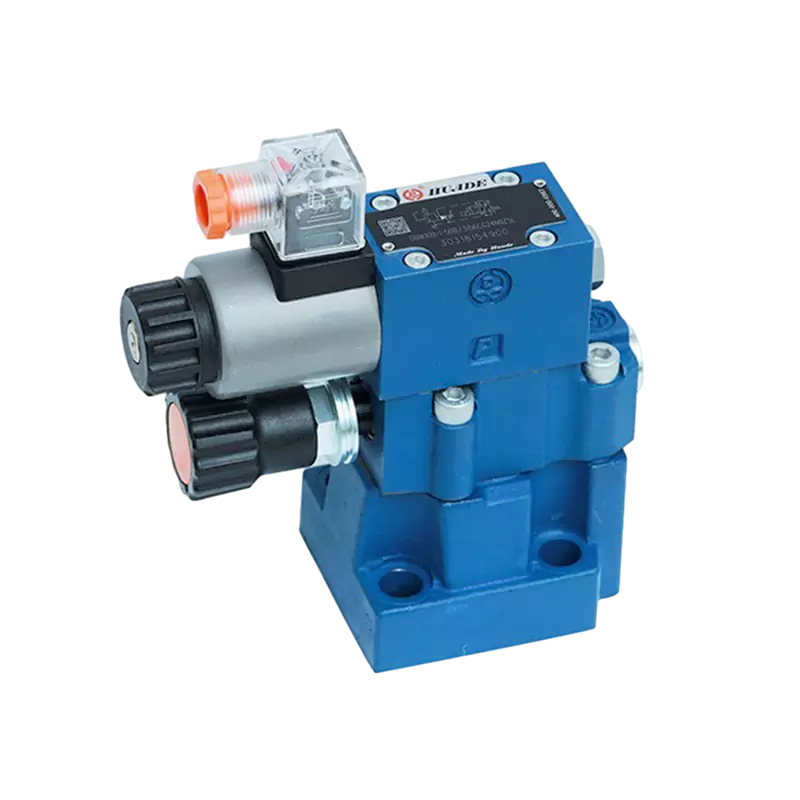
At its core, a proportional flow control valve uses a variable electromagnetic force to adjust the valve spool's position against a spring.
- Standard Valve: The solenoid is an on/off switch. It snaps the spool to the end of its stroke.
- Proportional Valve: The solenoid (driven by a PWM amplifier) produces a force proportional to the input current.
Example: 25% Signal = 25% Spool Stroke (Low Flow); 75% Signal = 75% Spool Stroke (High Flow).
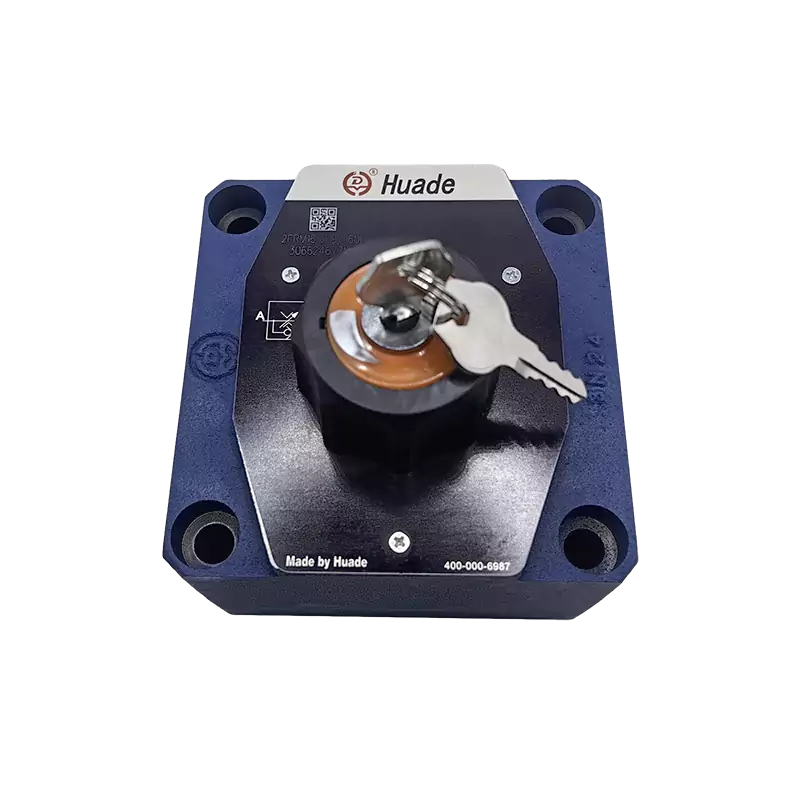
Without pressure compensation, the flow rate would drop if the load increased (because flow depends on pressure drop \( \Delta P \)). Most industrial proportional flow valves feature a built-in Hydrostat (Pressure Compensator). This mechanical device maintains a constant pressure drop across the throttle, ensuring that Flow remains constant regardless of load changes.
Proportional vs. Servo Valves: What’s the Difference?
This is the most common question we get. While both offer precise control, they are built for different purposes.
| Feature | Proportional Valve | Servo Valve |
|---|---|---|
| Precision |
Good (±1% to ±5%) Sufficient for industrial automation. |
Extreme (±0.1% to ±0.5%) Required for aerospace/testing. |
| Response Time | Medium (20ms - 100ms) | Fast (5ms - 15ms) |
| Oil Cleanliness | Tolerant (ISO 18/16/13) | Sensitive (ISO 15/13/10) |
| Cost | $$ (Moderate) | $$$$ (Very High) |
Key Specifications for Selection
A. Flow Rate (Q max)Always size the valve based on the controlled flow, not just the line size.
- Small: 0.2 - 30 L/min (e.g., NG6 / CETOP 3)
- Medium: 30 - 80 L/min (e.g., NG10 / CETOP 5)
- Large: > 200 L/min (e.g., Cartridge Logic Elements)
No Onboard Electronics (OBE): The valve just has a coil. You need a separate amplifier card (driver) in your control cabinet. Best for high-temperature environments.
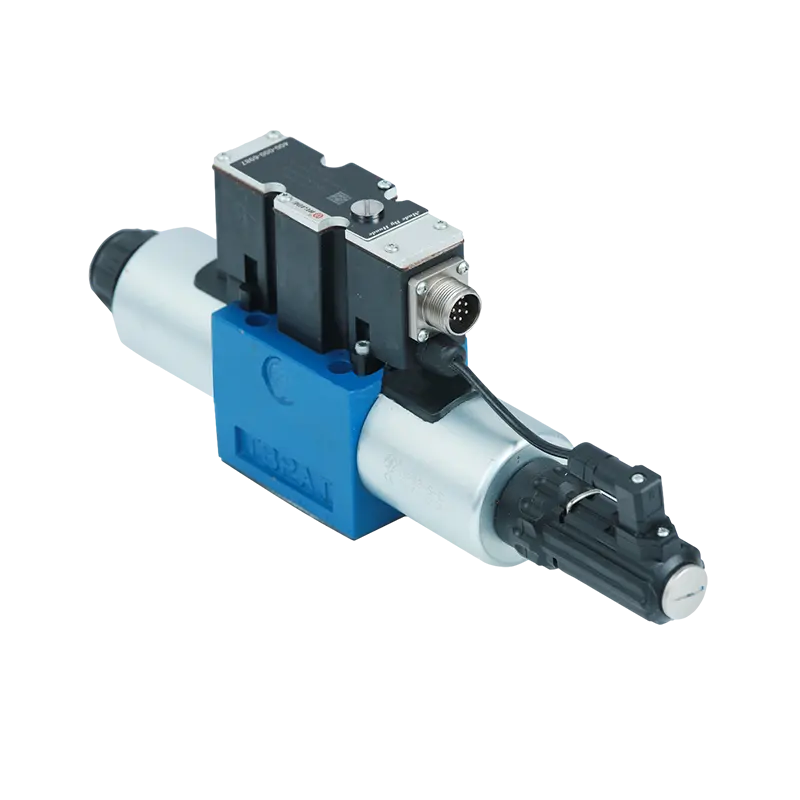
With Onboard Electronics (OBE): The amplifier is built into the valve cap. You plug in 24V and your command signal (0-10V) directly. Easier to install but heat-sensitive.
C. Hysteresis (Deadband)Hysteresis is the difference in flow when increasing the signal vs. decreasing it.
- Open Loop: ~5% Hysteresis.
- Closed Loop (LVDT): <0.5% Hysteresis (Choose this for positioning tasks).
Troubleshooting Common Issues
| Symptom | Probable Cause | Fix |
|---|---|---|
| Flow is unstable ("Hunting") | Air trapped in solenoid | Bleed air using bleed screw. |
| Flow is unstable ("Hunting") | PID gains too high | Re-tune amplifier. Reduce P-gain. |
| Valve sticks (Stiction) | Contamination (Silting) | Check filtration. Ensure \( \beta_{10} > 75 \). |
| Valve sticks (Stiction) | Incorrect Dither | Check driver settings. Dither vibrates spool to break friction. |
Typical Applications & Downloads
Our proportional flow control valves are trusted in rugged environments like Hydraulic Presses (speed profile control), Winches, and Agricultural machinery.
Technical DownloadsLooking for a replacement? We offer drop-in replacements for standard 2-way and 3-way proportional flow control valves. [Contact our Engineering Team] for a quote today.