Let’s cut straight to the chase. If you are building a simple log splitter or a lube system, buying a piston pump is like buying a Ferrari to deliver pizza. It’s overkill, expensive, and frankly, too delicate for the job. But if you are designing a high-speed excavator or an industrial press, using a gear pump is financial suicide. You will save $500 upfront, but you’ll burn thousands in wasted fuel and heat generation within the first year.
I’ve spent 20 years designing hydraulic circuits, and I’ve seen this decision paralyze engineers. Today, we’re moving beyond the textbook definitions. I’m going to give you the real-world rules of thumb to help you decide.
1. The “Cheat Sheet” Decision Matrix
If you are in a rush, use this table. This is exactly how I make the initial call when a client hands me a spec sheet.
| Factor | Gear Pump (External) | Piston Pump (Axial Variable) |
|---|---|---|
| Best For… |
Cost & Durability Simple tasks, dirty environments, constant speed. |
Efficiency & Control High pressure, variable flow, precision tasks. |
| Pressure Limit | Max ~3,000 PSI (210 Bar) | Max ~5,000+ PSI (350+ Bar) |
| Efficiency | 85% (Drops rapidly as pressure rises) | 92%+ (Stays high even at max pressure) |
| Contamination |
High (The “Trash Pump”) Can chew through ISO 20/18/15 oil. |
Low (The “Princess”) Needs pristine ISO 17/15/12 oil or it dies. |
| Noise Level | Loud, high-pitched whining. | Lower frequency, humming sound. |
| Cost Index | $ (Cheap to buy, replace when broken) | $$$$ (Expensive, but repairable) |
2. The “Log Splitter” Rule: When to Choose a Gear Pump
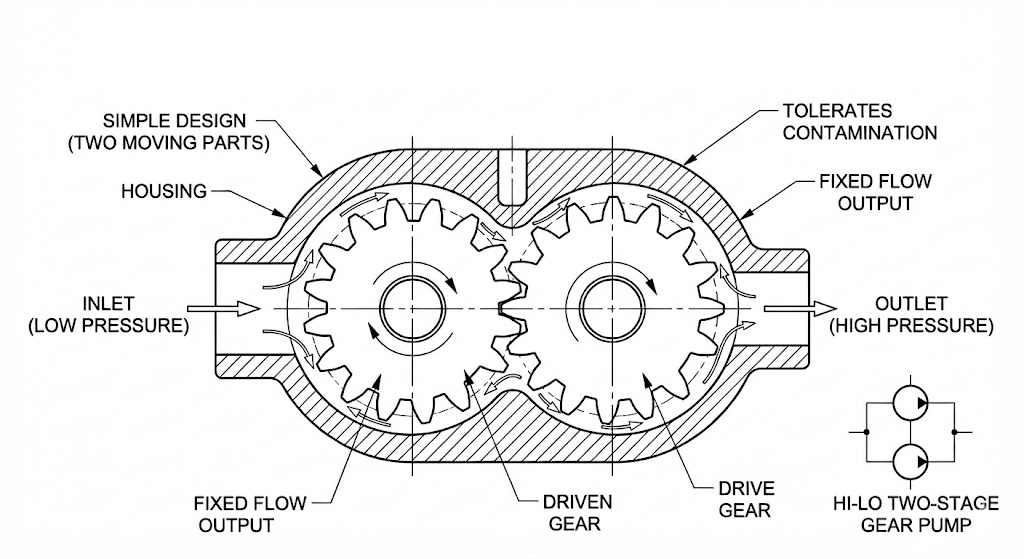
Scenario: You are building a machine that does one thing, over and over again, at full power. Think log splitters, trash compactors, or truck lift gates.
Why choose a Gear Pump?
- It’s Bombproof: Gear pumps are simple. Two gears mesh together and force oil out. There are no delicate slippers or swashplates. If your oil is a bit dirty (maybe you change filters once a year instead of once a month), a gear pump will groan but keep working. A piston pump would fail catastrophically.
- Cost is King: You can buy a standard aluminum gear pump for $150. A comparable variable piston pump starts at $800+. For a $2,000 machine, that math doesn’t work.
The Downside
- The “Scream”: At high pressures (near 3,000 PSI), gear pumps produce a distinct, ear-piercing whine. If your machine is indoors, your operators will hate you.
- Fixed Flow: It’s “all or nothing.” You can’t turn down the flow without changing the engine speed or dumping oil over a relief valve (which creates massive heat).
If you need two speeds (Fast Extend, Slow Crush) on a log splitter, don’t buy a piston pump. Buy a “Hi-Lo” Two-Stage Gear Pump. It’s a clever, cheap mechanical solution designed exactly for this.
3. The “Excavator” Rule: When to Choose a Piston Pump
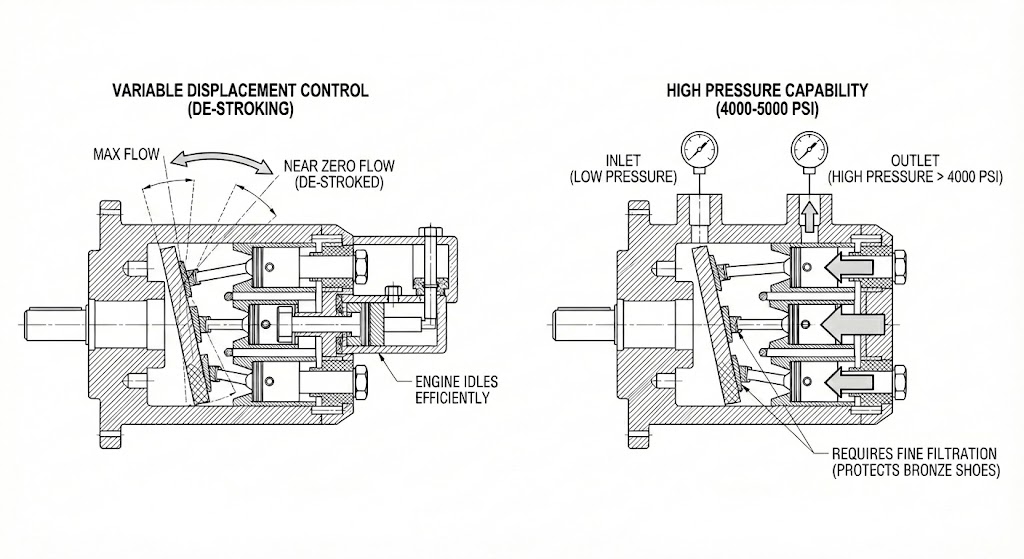
Scenario: You are designing a mobile machine (like a loader or excavator) or a factory power unit that runs 24/7. You need to control multiple cylinders at once, and fuel efficiency matters.
Why choose a Piston Pump?
- Variable Displacement (The Magic Trick): This is the killer feature. An axial piston pump can change its output flow without changing engine speed. Example: When an excavator is just sitting there, the pump “de-strokes” to near zero flow. The engine idles easily.
- High Pressure Capability: If you need 4,000 or 5,000 PSI to keep your cylinders small and powerful, a gear pump physically cannot do it. The internal leakage would be too high.
The Downside
Fragility: Piston pumps rely on a thin film of oil to lubricate the bronze shoes sliding on the swashplate. If a tiny piece of silica or metal shaving gets in there, it destroys the shoe. You cannot skimp on filtration.
4. The Hidden Cost: Why “Cheap” Gear Pumps Are Expensive
This is the conversation I have with factory owners. A gear pump is roughly 85% efficient. That means 15% of the electric power you pay for is converted directly into Heat, not work. A piston pump is 92-95% efficient.
If you have a 100 HP motor running 24/7:
- Gear Pump Wastage: You are wasting ~15 HP continuously.
- Piston Pump Wastage: You are wasting ~5 HP continuously.
That 10 HP difference? At industrial electricity rates, that can add up to $3,000 – $5,000 per year in wasted energy. If the pump runs more than 4 hours a day, the expensive piston pump usually pays for itself in electricity savings within 18 months.
5. Summary: What’s Your Next Move?
- Go with a Gear Pump if: Your pressure is under 3,000 PSI, your budget is tight, your oil isn’t perfectly clean, and the machine doesn’t run all day long.
- Go with a Piston Pump if: You need pressures over 3,500 PSI, you need variable flow control (Load Sensing), or energy efficiency is a priority for a continuous-duty machine.
Still not sure? Check your system cooling. If you have a massive cooler, you might get away with a gear pump. If your cooling capacity is limited, a load-sensing piston pump is the best way to stop your hydraulic system from overheating.