If you’ve ever looked at a hydraulic schematic and wondered, “How on earth does this metal block generate enough power to lift a 30-ton excavator arm?” you are not alone.
Gear pumps are easy to understand—they’re just two gears mashing oil. But Piston Pumps? They are the “Swiss Watch” of the hydraulic world. They are complex, expensive, and absolutely critical for high-pressure applications (up to 5,000+ psi) where efficiency matters.
As a hydraulic engineer who has torn down hundreds of these units, I’m going to skip the boring textbook definitions. Instead, I’ll show you exactly how they move, why they fail, and which type you actually need.
The Core Concept: “The Syringe Analogy”
Before we get into the rotating parts, let’s simplify the physics. Imagine a medical syringe.
- Pull the plunger back: You create a vacuum, sucking liquid in.
- Push the plunger in: You force liquid out.
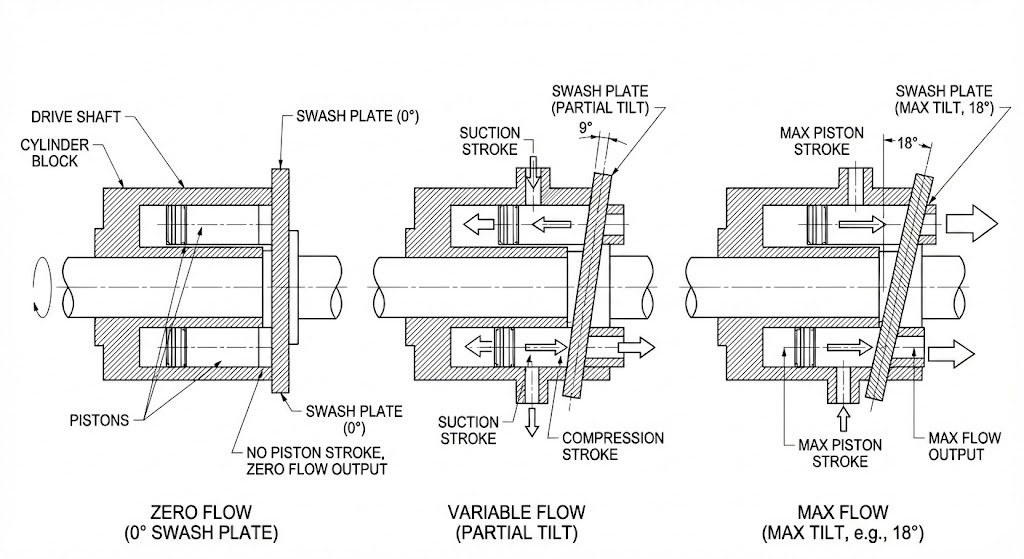
A Piston Pump is simply a rotating block containing 7 or 9 of these “syringes” (pistons). Instead of your thumb pushing them, a mechanical angled plate (the Swash Plate) forces them in and out as they rotate. This happens 2,000 times a minute. That rapid-fire “suck-squeeze-suck-squeeze” is what creates the massive flow of high-pressure oil.
Axial Piston Pumps: The Industry Standard
Best for: Mobile equipment like Excavators, Cranes, and Loaders.
This is the most common type you’ll encounter. The pistons are arranged in a circle, parallel to the driveshaft (like bullets in a revolver).
Imagine you are walking in a circle on a ramp:
- As you walk uphill, your legs retract (Compression Stroke → Pushing Oil Out).
- As you walk downhill, your legs extend (Suction Stroke → Sucking Oil In).
The Swash Plate is that ramp. The steeper the ramp, the more oil you pump.
The “Variable Displacement” Magic
Why are these pumps so popular? Because you can change their flow rate without changing the engine speed.
- Zero Flow: If the Swash Plate is flat (0° angle), the pistons don’t move in or out. The pump spins, but pumps nothing.
- Max Flow: Tilt the Swash Plate to its maximum angle (e.g., 18°), and the pistons take long strokes, pumping maximum oil.
Pro Tip: This is how a crane operator can move a heavy load millimeter by millimeter while the diesel engine is roaring at full RPM. The pump is just barely tilted.
Radial Piston Pumps: The High-Pressure Specialist
Best for: Industrial Presses, Plastic Molding, High-Pressure Clamping.
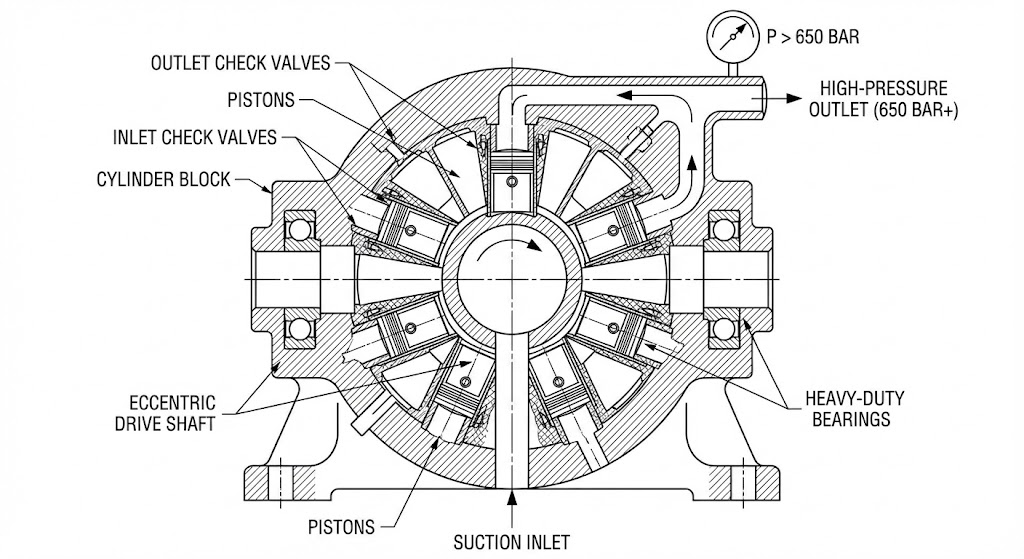
If Axial pumps are the “high-speed runners,” Radial pumps are the “weightlifters.” Here, the pistons are arranged like the spokes of a wheel (star shape). An eccentric shaft in the middle pushes them outward.
Why choose Radial?
- Insane Pressure: They can handle 650 bar (9,400 psi) or more easily.
- Long Life: The bearings load is better distributed, so they last forever in factory environments.
- Quiet: They don’t have the high-pitched “whine” of axial pumps.
Troubleshooting Guide: Connecting Principle to Failure
Knowing the principle helps you fix the problem. Here is a cheat sheet for mechanics.
| Symptom (现象) | Potential Cause | The “Why” (Engineering Logic) |
|---|---|---|
| Pump is noisy (Screaming sound) | Cavitation (气蚀) | The pump is trying to suck oil faster than the inlet allows. Vacuum bubbles form and implode, pitting the metal surfaces. Check your suction filter! |
| Low Pressure when oil is hot | Internal Leakage (内泄) | The “Syringe” seal is worn out. Hot oil is thin and slips past the piston back into the case instead of going to the system. |
| No Flow, even at full RPM | Broken Return Plate | The “Return Plate” (which pulls the pistons out) has snapped. The pistons are stuck inside the block and not reciprocating. |
| Sluggish response | Swash Plate Sticking | The control piston that tilts the swash plate is jammed with dirt (Silting). The pump is stuck at a low angle. |
FAQ: Your Questions Answered
Q: Why do piston pumps cost 10x more than gear pumps?
A: Precision. A gear pump has loose tolerances. A piston pump has clearances of 3-5 microns (smaller than a human blood cell). This precision gives them 95% volumetric efficiency, meaning they waste very little energy.
Q: Can I run a piston pump backwards?
A: Generally, No. Most piston pumps have a specific rotation direction (CW or CCW) due to the timing of the valve plate. Running it backward will suck oil from the pressure port and blow seals immediately.
Q: What is “Case Drain” and why is it hot?
A: Because the pistons must slide, a tiny bit of oil intentionally leaks past them to lubricate the moving parts. This oil collects in the case and drains back to the tank. If the case drain line is scorching hot, your internal leakage is too high—your pump is dying.
Are you seeing metal glitter in your hydraulic filter? That is likely the bronze from the piston “slippers” or the valve plate. Stop the machine immediately and inspect the Case Drain filter. If you catch it early, you can save the expensive housing; if you wait, you’ll be buying a whole new unit.