If you have ever stared at a hydraulic piston pump and wondered, “What exactly is happening inside this black box?” you are not alone. Whether you are a student trying to understand how a swashplate generates flow, or a technician trying to figure out which seal kit matches the exploded view on your workbench, standard textbook diagrams are often too flat or too fuzzy to be useful.
As a hydraulic engineer with 20 years in the field, I’m going to walk you through the diagrams that actually matter: the Cutaway (Physics), the Exploded View (Repair), and the ISO Schematic (System Design).
The Anatomy: Understanding the Cutaway Diagram
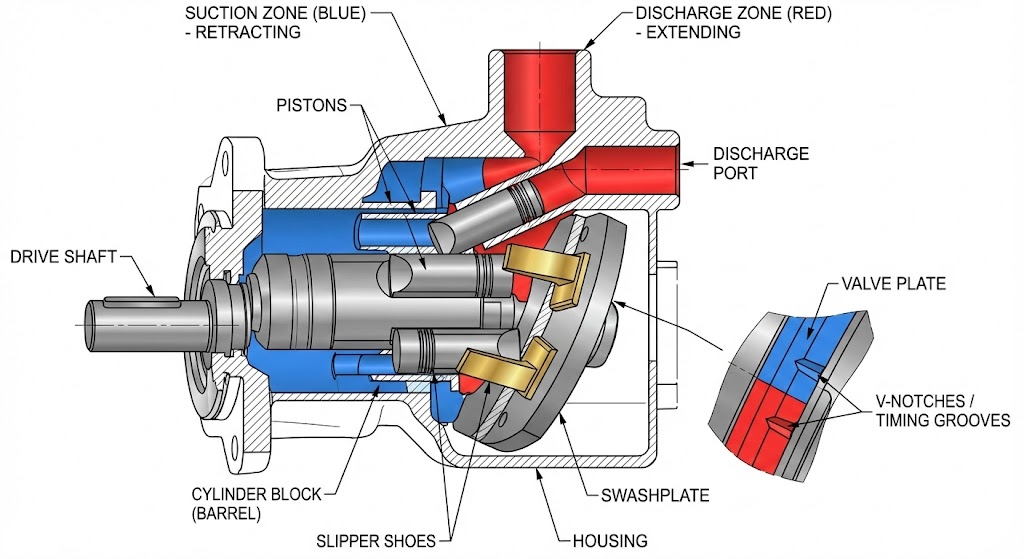
The most common search is for the Axial Piston Pump (Swashplate Design). This is the workhorse of mobile hydraulics (excavators, cranes). When you look at a cross-section diagram, focus on these three critical components:
The “Heartbeat” of the Pump
- The Cylinder Block (Barrel): This is the large rotating drum connected to the drive shaft. It holds the pistons.
- The Pistons & Shoes: Pistons move in and out of the barrel. The Slipper Shoes are the brass “feet” at the end of the pistons that glide on the swashplate.
- The Swashplate: The angled plate that doesn’t rotate. Its angle determines the stroke length of the pistons.
The “Red & Blue” Zones (High vs. Low Pressure)
On a high-quality diagram, you will see color coding to visualize the Transition Zone:
- 🔵 Blue Zone (Suction): As the piston retracts, it creates a vacuum. Atmospheric pressure pushes oil from the tank into the piston bore.
- 🔴 Red Zone (Discharge): As the barrel rotates, the piston is forced back in by the swashplate, squeezing oil out under high pressure (up to 400 bar).
Look closely at the Valve Plate (the interface between the rotating barrel and the back cover). You might see tiny “V-notches” or Timing Grooves. These aren’t defects; they are precision-machined to prevent Hydraulic Shock (noise) when the piston switches from low to high pressure.
The Mechanics: How Variable Displacement Works
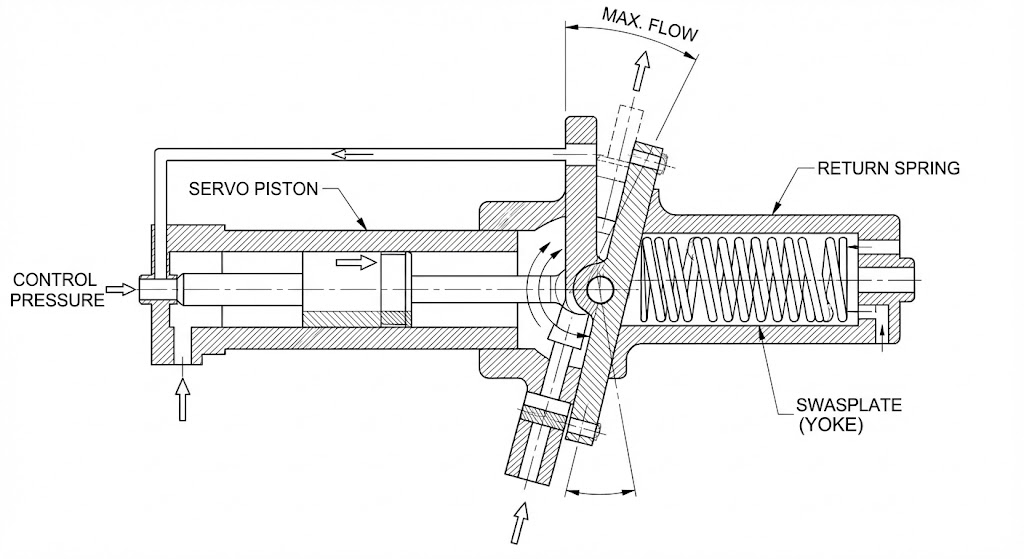
Why is the Swashplate so important? It is the key to Variable Displacement.
- Maximum Angle: Pistons travel full stroke. Maximum flow output.
- Zero Angle (Neutral): Swashplate is vertical. Pistons rotate but do not move in or out. Zero flow output.
Diagram: The Control Piston
In a detailed diagram, look for a smaller piston pushing against the swashplate. This is the Servo Piston.
- Physics: It fights against a large spring.
- Logic: By injecting oil behind this servo piston, we change the swashplate angle, thus changing flow on the fly. This is the secret behind Load Sensing (LS).
The Repair Bench: Exploded View & Common Failures
If you are fixing a pump, the Exploded View (Parts Breakdown) is your map. Here are the top 3 critical wear points you need to identify on the diagram.
| Part Name | What to Look For | The “Why” (Root Cause) |
|---|---|---|
| Slipper Shoes | Thinning, scratches, or loose fit. | Lubrication Failure. Oil too hot (low viscosity) causes metal-to-metal contact. |
| Valve Plate | Deep scores, smearing, erosion. | Contamination. Dirty oil (ISO code > 19/17/14) causes abrasion. |
| Shaft Seal | Leaking oil externally. | Case Drain Clog. Internal pressure build-up blows the seal out. |
The Engineer’s Language: ISO 1219 Symbols
If you are designing a system, you don’t need a picture of the metal; you need the Schematic Symbol.
1. The Basic Arrow
- Circle: Represents the pump.
- Triangle: Solid black pointing out = Hydraulic Pump (Flow source).
- Diagonal Arrow: Cuts through the circle = Variable Displacement.
2. The Confusing Lines (Load Sensing)
The most misunderstood part is the control box attached to the circle. Look for the dashed line coming from the system “X” port.
If you see this extra dashed line, it is a Load Sensing (LS) Pump. Do not replace it with a standard Pressure Compensated (PC) pump, or your machine will overheat and stall. The LS line tells the pump exactly how much pressure the load needs at that moment.
Summary: Which Diagram Do You Need?
- Student: Search “Axial Piston Pump Cutaway”. Focus on Swashplate angle.
- Technician: Search “[Brand] Exploded View”. Focus on Valve Plate and Slippers.
- Designer: Search “ISO 1219 Symbol”. Pay attention to Control Lines (LS vs PC).
Are you currently troubleshooting a pump that won’t build pressure? Before you tear it apart, check the Case Drain flow. If the pump is worn out, hot oil will bypass the pistons and flood out of the case drain line. It’s the quickest diagnostic test you can do without a diagram.