

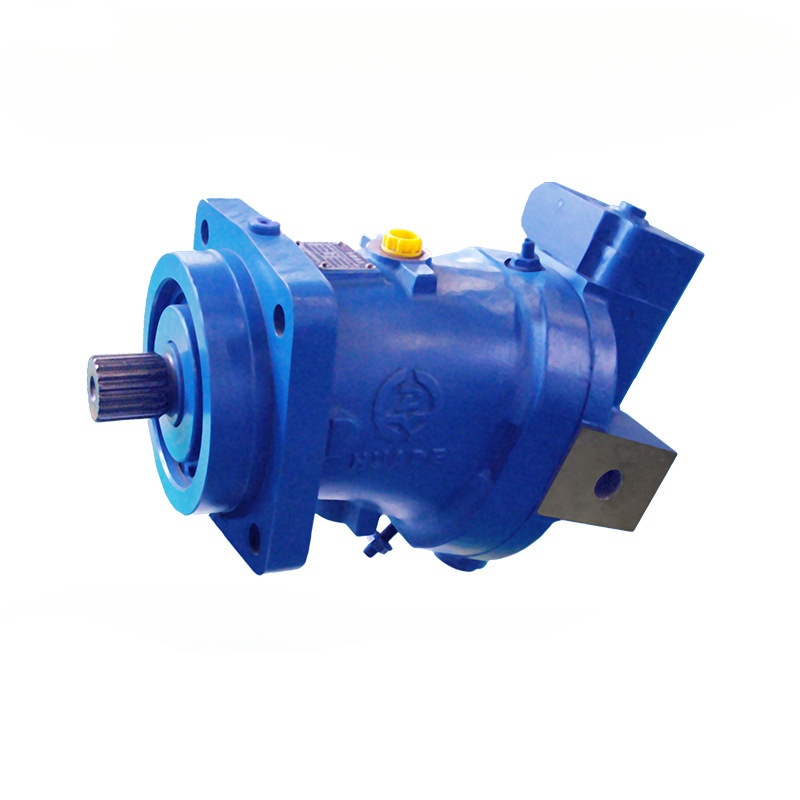



If you are looking for the "heart" of high-pressure hydraulic systems, you have found it. The Axial Piston Pump is the dominant power source in mobile hydraulics (excavators, cranes) and industrial machinery (presses, molding machines). Unlike gear pumps that simply "move" oil, axial piston pumps are designed to transform mechanical rotation into high-pressure fluid power with variable control.
This guide breaks down exactly how they work, the difference between Swash Plate and Bent Axis designs, and the physics behind the flow.
The Core Concept: From Rotation to Reciprocation
At its simplest level, an axial piston pump converts rotary motion (from an engine or motor) into linear reciprocating motion (of the pistons).
The Basic Setup: Imagine a revolver cylinder. Now, instead of bullets, put solid steel pistons in the holes.
- The Cylinder Block: Holds the pistons and rotates with the drive shaft.
- The Pistons: Arranged parallel to the drive shaft (hence "Axial").
- The Mechanism: To make the pistons move in and out while rotating, we need an angle. This is provided by the Swash Plate or by bending the axis itself.
Type A: Swash Plate Design (Most Common)
This is the standard design for variable displacement pumps used in most closed-loop and open-loop circuits.
How It Works (Step-by-Step)The cylinder block rotates, but the pistons stick out and rest against a stationary, angled plate called the Swash Plate.
- Suction Stroke (0° to 180°): As the cylinder rotates, the pistons follow the "downhill" slope of the swash plate. Springs or a retraction plate pull the pistons out, creating a vacuum that sucks oil in through the Valve Plate.
- Discharge Stroke (180° to 360°): As rotation continues, the pistons ride up the "uphill" slope. They are pushed back into the bore, squeezing oil out under high pressure.
If you change the angle of the swash plate, you change how far the pistons travel (stroke length).
- Steep Angle: Long stroke = High Flow.
- Flat Angle (0°): No stroke = Zero Flow (Idling).
This allows you to control hydraulic speed without changing engine speed.
Type B: Bent Axis Design (High Performance)
Used where efficiency and high pressure are critical (e.g., hydrostatic transmissions). Instead of an angled plate, the entire cylinder block is bent at an angle (usually 25° to 40°) relative to the drive shaft. As the shaft rotates, this angle mechanically forces the pistons to pump in and out.
| Feature | Swash Plate Design | Bent Axis Design |
|---|---|---|
| Geometry | Straight shaft, angled plate | Angled shaft/block |
| Efficiency | Good (Medium pressure) | Excellent (High pressure) |
| Durability | Good (side-load friction exists) | Superior (Less side load) |
| Size | Compact, easy to package | Bulky, "banana" shape |
| Application | General excavators, industrial | High-speed motors, heavy-duty |
Critical Components Breakdown
To understand the pump, you must know its parts.
- Pistons & Shoes: The pistons have bronze "shoes" (slippers) that glide on the swash plate. They rely on a tiny hydrostatic oil film to prevent metal-on-metal contact.
- Valve Plate: A stationary bronze plate with two kidney-shaped slots (suction and pressure). It separates the low-pressure side from the high-pressure side.
- Barrel (Cylinder Block): The rotating mass that houses the pistons.
Why Choose an Axial Piston Pump?
Why pay 10x the price of a gear pump?
1. Variable Displacement: Essential for Load Sensing (LS) systems to save fuel.
2. High Pressure: Can handle 350 bar (5000 psi) to 420 bar (6000 psi) continuously.
3. Efficiency: High volumetric efficiency (95%+) translates to less heat generation in the system.
Summary: The Axial Piston Pump works by rotating a barrel of pistons against an angled surface. Suction pulls pistons out; Discharge pushes them in; Control comes from changing the angle.