

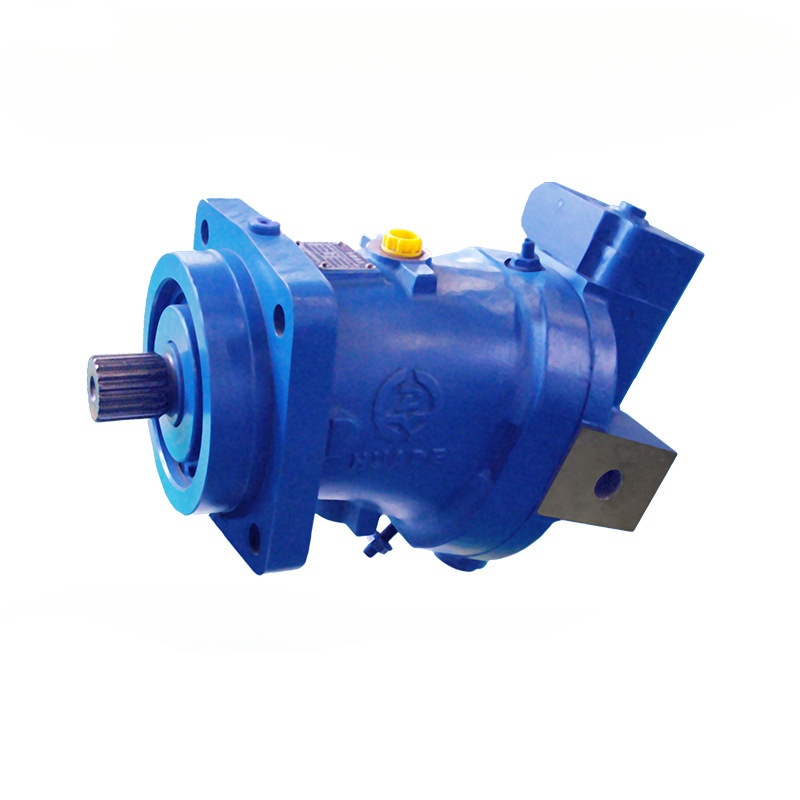



If you’re looking for a library-quiet environment, an axial piston pump probably shouldn’t be your first guest. In the hydraulic world, these pumps are the "heavy metal" performers—powerful, efficient, but undeniably loud.
Typically, an axial piston pump operates between 70 dB(A) and 95 dB(A). To put that in perspective, 70 dB is like a loud vacuum cleaner, while 95 dB is getting close to a handheld circular saw. If your pump is pushing toward that upper limit, you've officially crossed the threshold where OSHA requires hearing protection.
Noise Comparison: Where the Piston Pump Sits
Not all pumps scream the same way. If you are in the design phase, you need to know how the axial piston compares to its cousins.
| Pump Type | Typical Noise Range (dB) | Sound Characteristic | Pressure Capability |
|---|---|---|---|
| Internal Gear Pump | 60 – 75 dB | Low-pitched hum | Medium (Up to 315 bar) |
| Vane Pump | 65 – 75 dB | Soft whirring | Low-Medium (Up to 210 bar) |
| Axial Piston Pump | 70 – 95 dB | High-frequency pulsation | Very High (Up to 420 bar) |
| External Gear Pump | 80 – 100 dB | Harsh, high-pitched whine | Medium (Up to 250 bar) |
Why Is It So Loud? (The Engineering Reality)
The noise isn't a "defect"—it's a byproduct of physics. Specifically, it comes down to Flow Pulsation and Pressure Ripples.
As the Cylinder Block rotates, each piston moves from the low-pressure suction side to the high-pressure discharge side. When a piston suddenly opens to the discharge port, high-pressure oil from the system "backfills" into the lower-pressure piston chamber. This happens in microseconds, creating a tiny fluid explosion.
Multiply that by 9 pistons spinning at 1800 RPM, and you get a constant "drumbeat" of pressure spikes. We call this the fundamental frequency. You can calculate it as:
$$ f = \frac{n \cdot z}{60} $$Where \( n \) is the shaft speed (RPM) and \( z \) is the number of pistons. For a 9-piston pump at 1800 RPM, you’re dealing with a 270 Hz base frequency, plus all its higher harmonics.
Factors That Crank Up the Volume
If your system is louder than the datasheet suggests, one of these three variables is likely the culprit:
- Rotational Speed (RPM): This is the biggest factor. Noise levels generally increase with the square of the speed.
- System Pressure: Higher pressure means more violent "backfilling" at the valve plate. Expect a 2-3 dB increase for every 100 bar of additional pressure.
- Swashplate Angle: In variable displacement pumps, the noise signature changes as the Swashplate Angle moves. Ironically, some pumps are louder at partial displacement because of the timing of the pressure transition.
To hit your flow target \( Q \) quietly, it is almost always better to choose a larger displacement pump running at a lower RPM than a small pump screaming at high RPM.
Normal Hum vs. "Something Is Wrong"
As an engineer, you need to develop an ear for the "bad" noises. Use this diagnostic guide:
The High-Pitched Scream (Cavitation):
This sounds like someone is pouring gravel into your pump. It happens when the suction side can't get enough oil, causing vapor bubbles to collapse violently. Check your suction strainer immediately.
The Erratic Knocking (Aeration):
Similar to cavitation but more "ragged." This is air being sucked in through a loose fitting or a bad shaft seal. You’ll usually see foam in the oil tank.
The Rhythmic "Clack" (Mechanical Wear):
If you hear a steady metallic knocking that follows the pump speed, your Piston Slippers might be worn or the Retainer Plate is loose. This is a "stop the machine" moment before the pump grenades itself.
5 Practical Tactics to Kill the Noise
You can’t make the pump silent, but you can stop the machine from acting like a giant loudspeaker.
- The "One Meter Hose" Rule: Never connect a rigid steel pipe directly to the pump outlet. Use a high-pressure rubber hose at least one meter long. It acts as a "damper" for the fluid-borne noise.
- Anti-Vibration Mounts: Use rubber "bell housing" gaskets and damping rods between the motor and the pump. This decouples the Structure-Borne Noise from the oil tank.
- Submerged Installation: If possible, mount the pump inside the oil tank. The hydraulic oil acts as a natural sound insulator.
- Tuned Silencers: For high-stakes NVH environments, you can install a Hydraulic Silencer (essentially a muffler for oil) on the discharge line to cancel out specific frequencies.
- Proper Case Drain Routing: Ensure your Case Drain Pressure is low (usually under 2 bar). Excessive backpressure in the housing forces components to vibrate more violently.
Would you like me to help you calculate the specific noise frequency for your current RPM and piston count, or perhaps help you draft a troubleshooting checklist for a pump that has suddenly become louder?