




If you’ve ever looked at an axial piston motor diagram and felt like you were staring at a watch movement designed by a giant, you aren't alone. I remember my first time on a teardown table with a Rexroth MCR series; it looks like a simple hunk of iron from the outside, but inside, it’s a high-speed dance of tolerances and fluid dynamics.
Whether you are a student trying to visualize how oil turns a shaft or a tech wondering why your motor is "puking" oil out of the case drain, this guide is for you. We’re going to strip away the jargon and look at the actual mechanical logic.
The Anatomy: What are you looking at?
When you pull up a diagram, don't just see a "motor." See a transformer. It takes high-pressure oil and turns it into torque. Here are the "Big Four" components you’ll see in any professional schematic:
- The Pistons: These are the workers. They sit inside the cylinder block. High-pressure oil pushes them "out," but because they hit a slanted surface, they are forced to slide, which creates rotation.
- The Cylinder Block (Barrel): This holds the pistons and rotates with the main shaft. If this part is scored or scratched, your efficiency drops through the floor.
- The Valve Plate (The Brain): This is a flat, kidney-shaped plate. It times exactly when oil enters and leaves each piston. If this plate is worn, the motor will "hunt" or lose power under load.
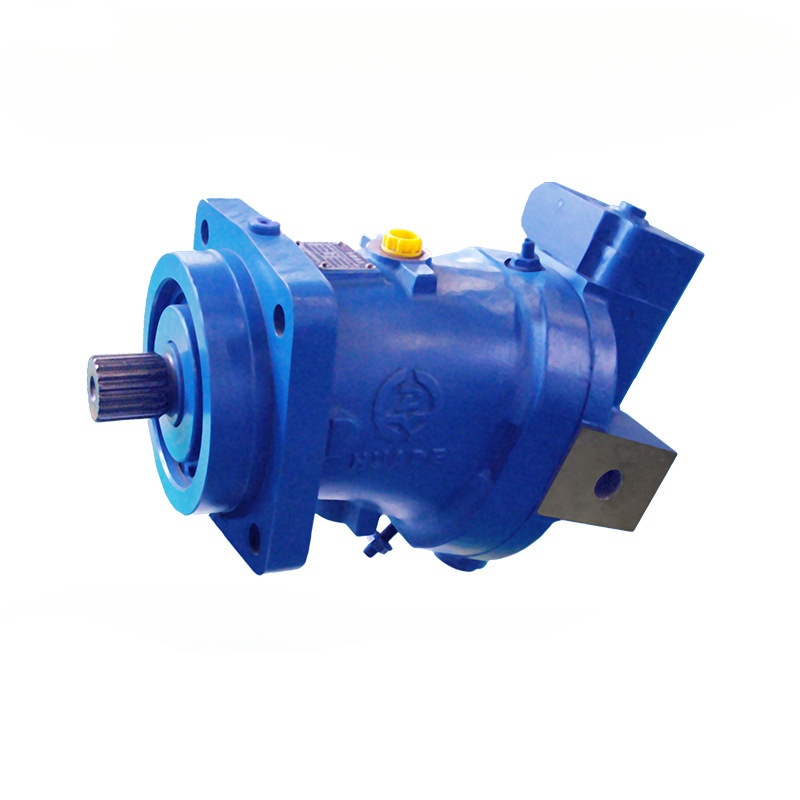
- The Swashplate or Bent Axis: This is the slanted part. The steeper the angle, the more torque you get, but the slower the motor spins.
The Great Debate: Swashplate vs. Bent Axis
Most diagrams you find will fall into one of two categories. You need to know which one you’re looking at because they fail in very different ways.
| Feature | Swashplate Design (Straight) | Bent Axis Design (Angled) |
|---|---|---|
| Visual Profile | Linear, compact, cylinder-shaped. | "Bent" or "Banana" shaped housing. |
| Starting Torque | Good, but suffers from "side load" friction. | Superior. Direct leverage on the shaft. |
| Max RPM | Lower (usually < 3500 RPM). | High. Can scream at 6000+ RPM. |
| Common Failure | Slipper pads "lifting" or scoring. | Center pin or universal joint wear. |
How Pressure Becomes Torque (The Math)
You don't need to be a mathematician to fix a motor, but you do need to understand how \( P \) (Pressure) becomes \( T \) (Torque). In an axial motor, the torque is generated by the horizontal component of the force pushing against that slanted plate.
The theoretical torque (\( T_{th} \)) for an axial piston motor is calculated as:
$$ T_{th} = \frac{V_g \cdot \Delta p}{20 \cdot \pi} $$Where:
- \( V_g \) = Displacement per revolution (\( cm^3 \))
- \( \Delta p \) = Pressure differential (\( bar \))
If your motor has plenty of pressure but won't turn the load, your mechanical efficiency (\( \eta_m \)) has likely tanked due to internal friction or a "seized" piston.
The "Secret" Port: The Case Drain
Look at your diagram again. See that small, third port usually located at the top of the housing? That’s the Case Drain. In an axial piston motor, the pistons aren't 100% sealed. A tiny bit of oil must leak out to lubricate the Slipper Pads and the Valve Plate. This oil collects in the motor housing.
The Golden Rule: Always connect the case drain directly to the tank.
The Consequence: If you plug this port, the pressure inside the housing will blow your shaft seal out like a cork from a champagne bottle. Worse, it can lift the pistons right off the plate, causing a catastrophic "munching" of metal.
Troubleshooting via the Diagram
When a motor fails, I use the diagram to visualize where the "heat" is coming from.
- Motor is scalding hot but not moving: This usually points to the Valve Plate. High-pressure oil is "short-circuiting" directly to the low-pressure side or the case drain. It's like a leaky faucet that’s also a blowtorch.
- Rhythmic "knocking" sound: Check the pistons in your diagram. A "marbles in a blender" sound usually means you have Cavitation or a broken Retainer Plate that is letting the pistons flop around.
- Seal Leakage: If you see oil dripping from the shaft, your internal case pressure is too high. Check your drain line for kinks or a clogged return filter.
Maintenance for Longevity
If you want your motor to last 10,000 hours instead of 1,000, you need to respect the ISO 4406 Cleanliness Standards. Most axial motors require a minimum of 18/16/13.
If you can see the dirt in your oil, it’s already too late. Particles as small as 5 microns (invisible to the eye) can act like sandpaper on the valve plate, eventually leading to a loss of volumetric efficiency (\( \eta_v \)).