

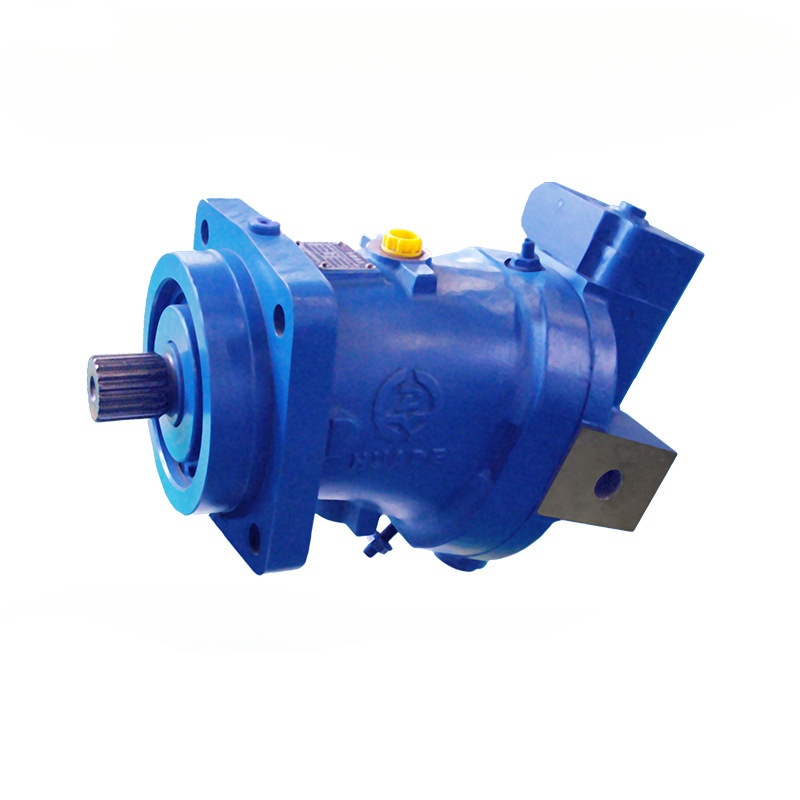



If you’ve ever stood next to a 40-ton excavator and wondered how a relatively small metal component makes those massive tracks spin, you’re looking at the magic of the axial piston motor. I’ve spent two decades tearing these apart on greasy shop floors and designing them in clean labs. I can tell you one thing for sure: if you can't read the diagram, you can't fix the machine.
Decoding the Axial Piston Motor Diagram

Most people see a jumble of lines and circles, but a senior engineer sees a high-pressure dance. The core of any axial piston motor diagram consists of three functional zones: the rotating group, the timing interface, and the output shaft.
- The Cylinder Block (Barrel): This is the rotating housing that holds the pistons. It’s usually made of high-strength alloy steel or ductile iron to handle pressures up to 400 bar.
- The Pistons & Slipper Pads: These are the "legs" of the motor. As high-pressure oil enters the cylinders, it pushes the pistons out. The Slipper Pads ride on a microscopic oil film against the swash plate.
- The Valve Plate (Port Plate): This is the "timing belt" of the hydraulic world. It ensures oil enters and leaves the cylinders at exactly the right micro-second.
If you see tiny "V" or "U" shaped notches on the valve plate in your diagram, those aren't manufacturing defects. Those are Silencing Grooves. They prevent the "hydraulic hammer" effect by smoothing out the pressure transition as each piston moves from the low-pressure side to the high-pressure side.
Swash Plate vs. Bent Axis: Which One Do You Need?
In the B2B world, choosing the wrong motor architecture is an expensive mistake. You’ll usually run into two main types: Swash Plate (straight) and Bent Axis (angled).
| Feature | Swash Plate (In-Line) | Bent Axis (Canted) |
|---|---|---|
| Max Efficiency | ~90-93% | ~95-98% |
| Startup Torque | Moderate (higher friction) | High (direct force transfer) |
| Max Speed | Medium | Extremely High |
| Common Use | Industrial drives, Auxiliary circuits | Track drives, Winches, Heavy fans |
I generally recommend Bent Axis motors for heavy-duty travel drives. Why? Because they lack the slipper-to-swashplate friction interface. This gives them a much higher startup torque efficiency—often reaching 94%, compared to the 80% you’ll see in many swash plate designs. If your machine feels "sluggish" when trying to climb a hill, your motor choice is likely the culprit.
The Physics of Torque and Speed
You don't need a math degree to understand motor performance, but you do need to know how Displacement (\( V_g \)) affects your output. The theoretical torque (\( T \)) produced by the motor is calculated as:
$$ T = \frac{V_g \cdot \Delta p \cdot \eta_{mh}}{20 \cdot \pi} $$Where:
- \( V_g \) = Displacement (cc/rev)
- \( \Delta p \) = Pressure differential (bar)
- \( \eta_{mh} \) = Mechanical-hydraulic efficiency
If your motor isn't hitting the required RPM, check your Volumetric Efficiency (\( \eta_v \)). This measures how much oil is leaking internally. As a motor wears down, the gap between the cylinder block and the valve plate grows. Even a 10-micron increase in that gap can cause a massive drop in speed under high load.
Maintenance: The "Silent Killers"
I’ve seen $15,000 motors turn into scrap metal because of two things: Contamination and Case Pressure.
1. The ISO 4406 StandardHydraulic oil isn't just "juice"; it's a precision lubricant. For an axial piston motor to survive, your oil cleanliness must meet ISO 4406 18/16/13 or better. If your oil looks "milky" or "cloudy," you have water or air ingress. Air leads to Cavitation—tiny bubbles that implode with enough force to pit solid steel.
2. Case Pressure & Shaft SealsEvery axial piston motor has internal leakage designed to lubricate the moving parts. This oil collects in the housing and exits through the Case Drain.
If your case drain line is restricted or the filter is plugged, the pressure inside the motor housing will spike. This usually results in a "blown" shaft seal. Worse, high case pressure can actually lift the slipper pads off the swash plate (known as Slipper Separation), leading to a catastrophic mechanical failure.
Troubleshooting Checklist for the Field
If your motor is acting up, start with these three checks before you pull it off the machine:
- Check Case Leakage: Measure the flow from the case drain line. If it’s significantly higher than the manufacturer’s spec (usually about 5-10% of total flow), your internal parts are worn out.
- Listen for "Marbles": A loud, rattling noise usually means Cavitation. Check your charge pressure—it should usually be between 20 and 30 bar in a closed-loop system.
- Feel the Temperature: If the motor housing is significantly hotter than the hydraulic tank, you have an internal "short circuit" where high-pressure oil is leaking directly to the case.
Would you like me to analyze a specific set of performance data from your machine to see if your motor is reaching its end-of-life, or should we look at a comparison between two specific brands like Rexroth and Danfoss?