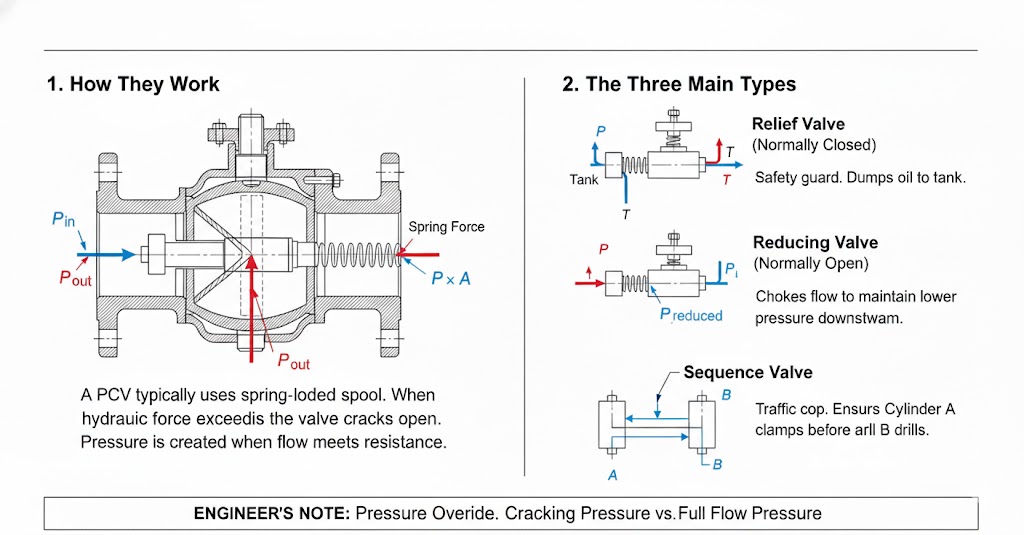
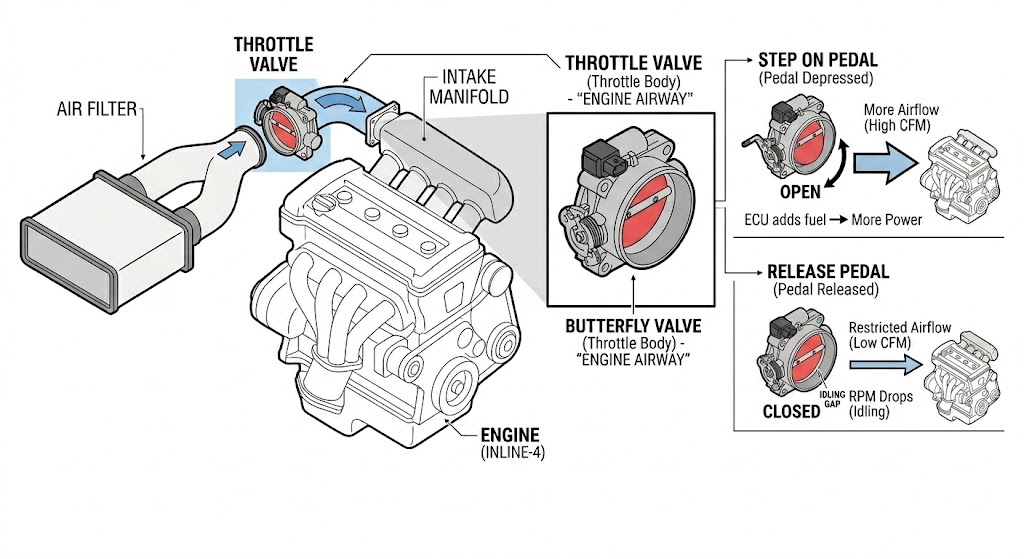
When engineers ask which valve type works best for controlling flow, they’re really asking about throttling capability—the ability to modulate flow rate precisely rather than just opening or closing a line. The answer depends entirely on your application requirements: pressure differential, required precision, fluid characteristics, and operational constraints. Globe valves dominate precision control applications, while V-port ball valves excel in slurry services, and butterfly valves offer cost-effective solutions for large diameters.
Why Globe Valves Remain the Industry Standard
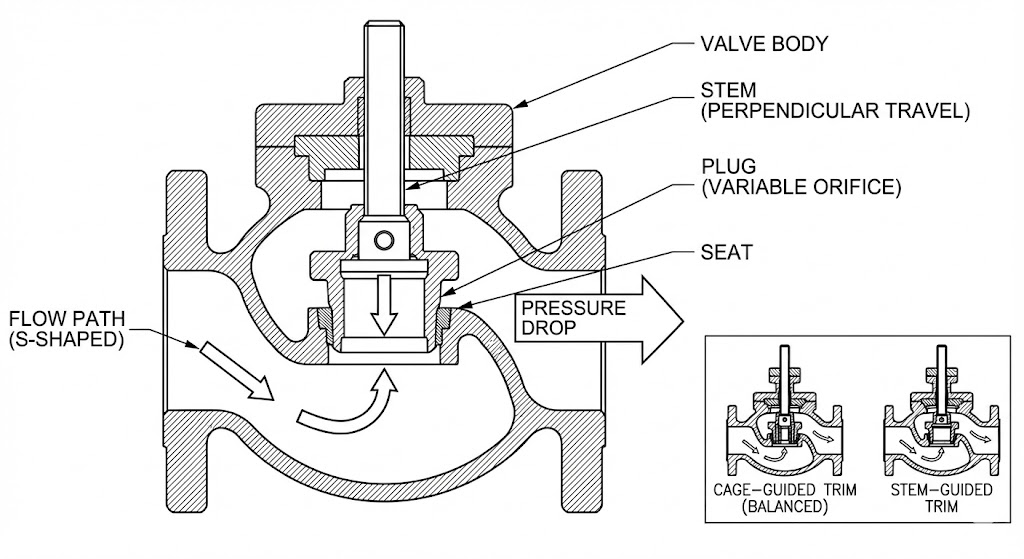
Globe valves achieve their control authority through a fundamental design principle: forcing fluid through an S-shaped or Z-shaped flow path. The valve plug moves perpendicular to the seat, creating a variable orifice that changes the flow area linearly with stem travel.
The tortuous flow path creates high resistance, translating to a lower flow coefficient ($C_v$) compared to rotary valves (typically 50-70% less). However, this high resistance provides better control resolution at small openings and reduces sensitivity to upstream pressure fluctuations.
Cage-Guided vs. Stem-Guided Designs
The internal trim configuration significantly impacts performance. Cage-guided valves use a cylindrical sleeve to support the plug, eliminating vibration under high differential pressures (>500 psi). Stem-guided designs are simpler but susceptible to lateral deflection, limited to clean fluids below 200 psi drop.
| Trim Type | Rangeability | Max ΔP (psi) | Best Application |
|---|---|---|---|
| Cage-Guided Balanced | 50:1 | 2000+ | High pressure drop, clean service |
| Stem-Guided | 30:1 | 200 | Low pressure, small size |
| Port-Guided (Needle) | 100:1 | 5000 | Micro-flow, instrumentation |
Cavitation Resistance
Multi-stage trim designs divide the total pressure drop into multiple smaller steps (50-150 psi each), staying above vapor pressure to prevent cavitation. This allows globe valves to handle liquid pressure drops up to 3000 psi without damage.
When V-Port Ball Valves Outperform Globe Valves
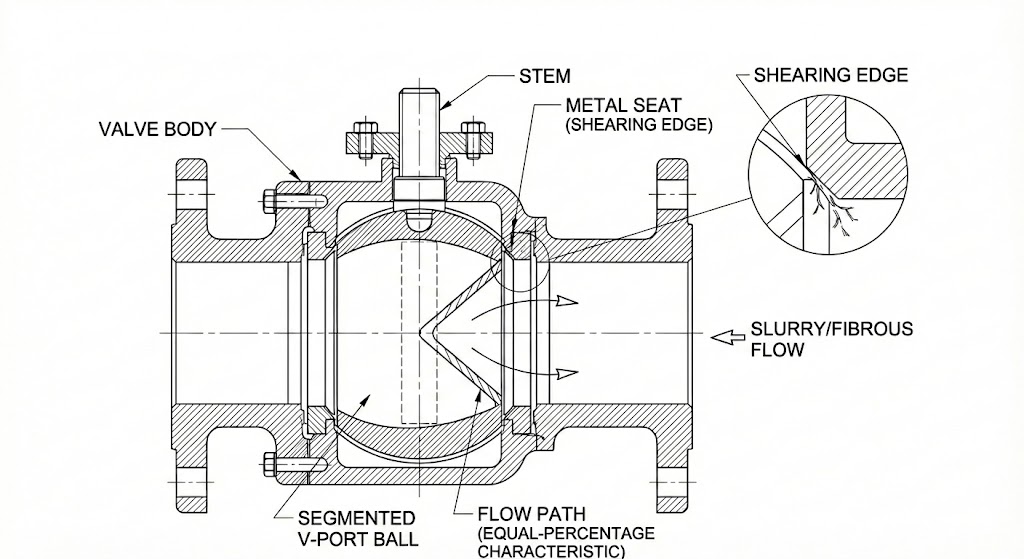
Traditional full-port ball valves make poor throttling devices due to their quick-opening characteristic. However, segmented V-port ball valves utilize a V-notch cut into the ball. This creates a characterized opening that increases exponentially with rotation angle, delivering an equal-percentage characteristic ideal for process control.
The Shearing Advantage: The V-notch edge acts like a guillotine against the metal seat during closure. This shearing action cuts through fibers and suspended solids that would jam a globe valve, making V-port valves essential for paper mills and mining slurries.
Limitation: High pressure recovery ($F_L approx 0.6$) makes them prone to cavitation. Limit usage to $Delta P < 300$ psi in liquid service unless the cavitation index $sigma$ confirms safety.
Butterfly Valves: Large Diameter Flow Control on a Budget
For pipe sizes >6 inches, butterfly valves are compelling. A 12-inch butterfly valve costs 60-70% less and weighs 80% less than an equivalent globe valve.
| Design | Effective Range | Rangeability | Max Pressure (ANSI) |
|---|---|---|---|
| Concentric | 30-70% stroke | 15:1 | 150 |
| Double-Offset | 10-80% stroke | 25:1 | 600 |
| Triple-Offset | 10-90% stroke | 40:1 | 1500 |
Pressure Drop: The $C_v$ is 3-4 times higher than a globe valve, offering significant energy savings. However, cavitation risk is high; typically requires $sigma > 1.5$.
Matching Flow Characteristics to Process Dynamics
- Linear Characteristics: Ideal for systems where pressure drop remains constant regardless of flow (e.g., level control).
- Equal Percentage: Compensates for variable system pressure drop (pipe friction). As flow increases and available $Delta P$ decreases, the valve gain increases. This yields a linear installed characteristic, which is why 80% of process valves use equal percentage trim.
Specialized Valves for Extreme Conditions
Pinch Valves (Abrasive Slurries)
Uses a thick elastomer sleeve squeezed by external pressure. The sleeve absorbs particle impacts without cutting. Ideal for mining tailings and fly ash (2-5 year life vs 2-5 months for metal valves). Limited to 150 psi / 180°F.
Diaphragm Valves (Sterile Services)
Flexible membrane isolates actuator from process. No stem crevices for bacteria. Electropolished bodies meet ASME BPE standards for CIP/SIP protocols in pharmaceutical applications.
Noise and Vibration: The Hidden Selection Criteria
High-velocity gas flow (>$0.3$ Mach) generates aerodynamic noise. Standard valves create one large jet; low-noise trim splits this into hundreds of micro-jets, shifting frequency to the ultrasonic range. This adds 40-60% to cost but eliminates downstream silencers.
The Selection Decision Framework
- High ΔP Liquid (>500 psi): Cage-guided Globe Valve (Anti-cavitation trim).
- Fibrous/Dirty Service: V-port Ball Valve (Shearing action).
- Large Diameter (>8″) + Moderate Precision: High-Performance Butterfly Valve.
- Abrasive Slurries (<150 psi): Pinch Valve.
- Sterile Process: Diaphragm Valve (ASME BPE).
- Wide Rangeability (>50:1): V-port Ball Valve.
Success depends on matching inherent characteristics—flow capacity, pressure recovery, and robustness—to specific fluid demands. Start by calculating required $C_v$ and evaluating cavitation potential ($sigma$) to eliminate guesswork.