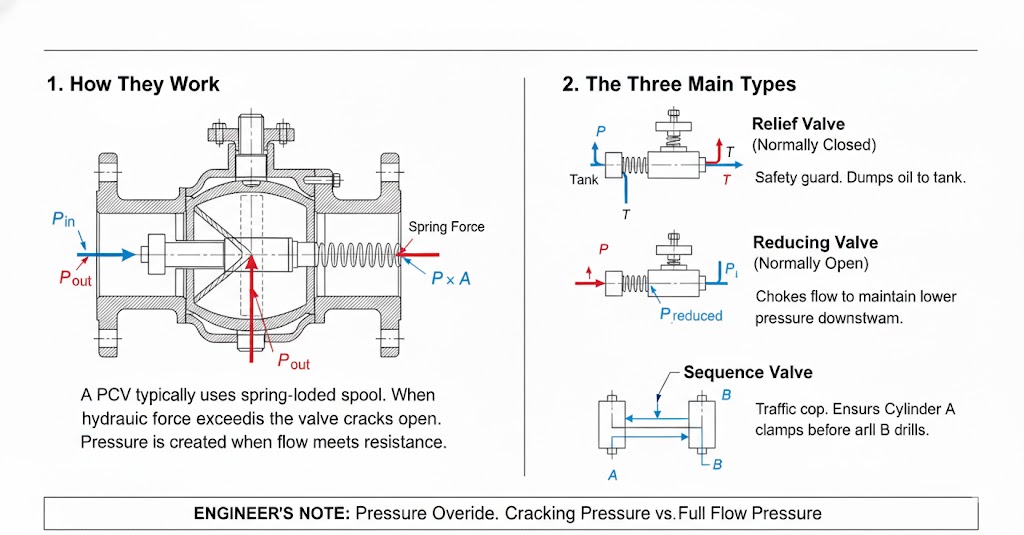
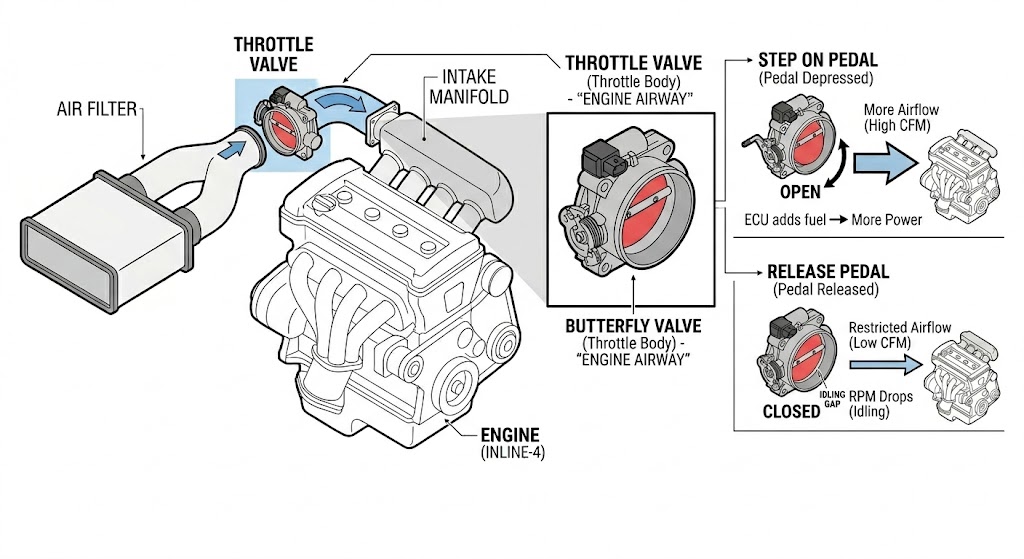
A one-way flow control valve combines directional control with adjustable flow restriction in a single compact unit. This dual-function component uses an internal check valve paired with a throttle element to regulate fluid flow in one direction while allowing unrestricted reverse flow. Engineers rely on these valves to control the speed and smoothness of pneumatic cylinders and hydraulic actuators across manufacturing, aerospace, and medical equipment.
For complete selection guidelines and cross-reference documentation on this product line, please consult our hydraulic flow control valves technical guide.
How One-Way Flow Control Valves Work
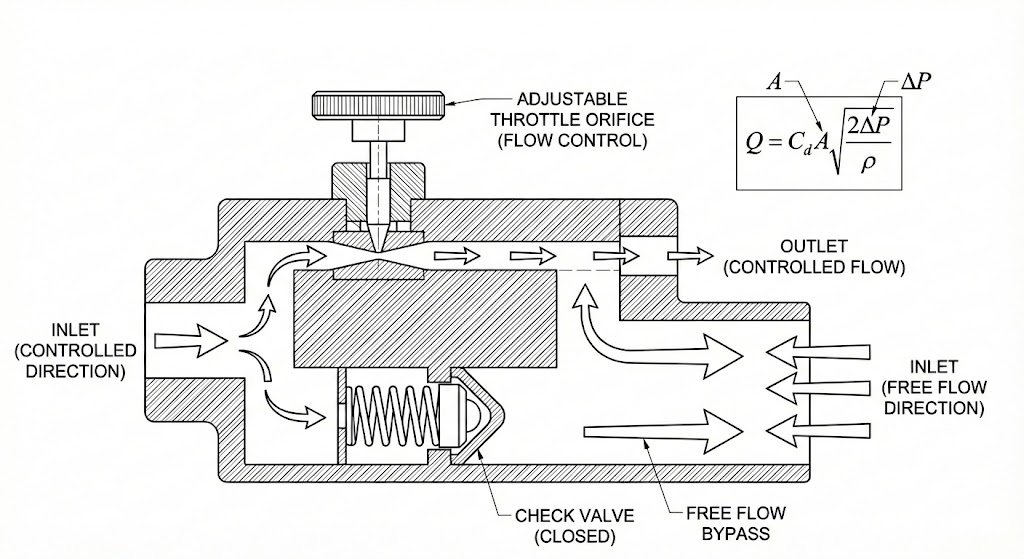
The valve contains two parallel flow paths within one body. When fluid enters from the controlled direction, pressure forces the check valve closed. This directs all flow through an adjustable orifice—typically a tapered needle against a seat. Turning the adjustment knob changes the needle position and therefore the flow area.
The relationship between flow rate and pressure follows basic fluid mechanics. For incompressible fluids like hydraulic oil, the flow rate $Q$ through the orifice relates to pressure drop $Delta P$ by:
$$ Q = C_d A sqrt{frac{2 Delta P}{rho}} $$
Here $C_d$ represents the discharge coefficient, $A$ is the effective flow area, and $rho$ is fluid density. By physically restricting area $A$, the valve creates an engineered pressure drop that limits volume flow rate and controls actuator speed.
When flow reverses, inlet pressure acts on the front face of the check valve element. Once pressure exceeds the cracking pressure—usually 0.03 to 0.05 MPa for pneumatic valves—the spring-loaded check opens. Fluid bypasses the throttle entirely through this large-area path, allowing maximum return speed without restriction.
Air compressibility creates distinct control characteristics. As compressed air expands through the throttle orifice, density and temperature drop (Joule-Thomson effect). When the pressure ratio falls below ~0.528, flow becomes choked at sonic velocity.
Hydraulic oil is incompressible but exhibits strong viscosity-temperature dependence. Advanced designs use thin-wall sharp-edge orifices to maintain turbulent flow, making performance independent of oil temperature drift.
Flow Capacity Ratings: $C_v$ and $K_v$ Values
Selecting valves by port size alone provides insufficient information. The industry uses standardized flow coefficients to quantify valve capacity under reference conditions.
| Parameter | Test Conditions | Units | Standard | Conversion |
|---|---|---|---|---|
| $C_v$ | Water at 60°F, 1 psi drop | US gpm | ISA S75.01 | $C_v = 1.16 K_v$ |
| $K_v$ | Water at 5-30°C, 1 bar drop | m³/h | VDI/VDE 2173 | $K_v = 0.86 C_v$ |
Valve Construction and Materials
Body Configurations: Banjo-style mounting dominates pneumatic automation, allowing 360° rotation and direct mounting to cylinder ports to minimize dead volume. Inline installation places the valve in mid-piping, ideal for inaccessible cylinder locations or logic circuits.
| Material | Pressure Rating | Corrosion Resistance | Typical Applications |
|---|---|---|---|
| Nickel-plated brass | ~60 bar | Good (general) | Factory automation, compressed air |
| Stainless steel 316 | ~400 bar | Excellent (acids) | Marine, food/beverage (FDA), pharma |
| Anodized aluminum | Medium | Good after treatment | Pneumatic manifolds, aerospace |
| Engineering polymer | <10 bar | Excellent (specific) | Water treatment, disposable medical |
Internal Check Valve Designs:
- Poppet-style: Conical element with line contact. Self-compensating for wear, excellent sealing in contaminated systems.
- Ball-type: Simple and inexpensive, but prone to chatter and instability in pulsating flow.
- Diaphragm: Zero sliding friction, used in medical circuits for low-pressure sensitivity.
Meter-Out vs Meter-In Control Strategies
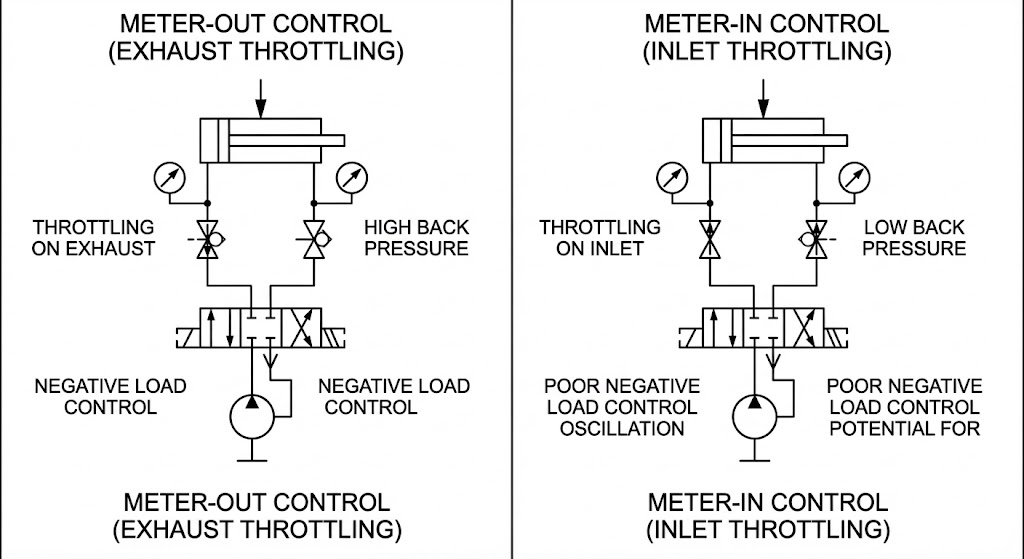
Installing direction determines fundamental system behavior. This choice between meter-out and meter-in control affects load handling, motion smoothness, and safety.
| Characteristic | Meter-Out (Exhaust Throttling) | Meter-In (Inlet Throttling) |
|---|---|---|
| Motion smoothness | High (back pressure damping prevents stick-slip) | Low (prone to jerking and oscillation) |
| Negative load control | Strong (prevents free-fall) | Poor or dangerous (loss of control) |
| System stiffness | High | Low |
| Startup behavior | Immediate force application | Delayed until inlet pressure builds |
| Primary applications | General automation, vertical loads, variable forces | Spring-return cylinders, constant positive loads |
Industry-Specific Applications
Medical Life Support Systems
PEEP valves in mechanical ventilators function as precision spring-loaded check valves to prevent lung collapse. Manual resuscitators use dual one-way valve logic to prevent rebreathing of expired gas.
Aerospace Fuel and Hydraulic Systems
Miniaturized components like Lee Chek® valves withstand high pressures in fuel injection systems, preventing dripping and coking. Landing gear circuits use complex logic with meter-out control for extension and free-flow for rapid retraction.
High-Speed Packaging and Robotics
Independent flow control on both cylinder ports allows asymmetric velocity profiles—fast extension for cycle time optimization, and slow retraction for soft landing.
Installation and Tuning Best Practices
- Initial Setting: Close fully, then open 1/4 to 1/2 turn. Prevents “cannon shot” effect.
- Safe Pressurization: Apply pressure; actuator should move slowly.
- Incremental Adjustment: Rotate knob 1/8 to 1/4 turn at a time. Flow changes are nonlinear.
- Lockdown: Tighten lock nut to prevent vibration-induced drift.
- Documentation: Mark alignment with paint pen for visual verification.
Troubleshooting Common Failures
| Symptom | Probable Causes | Diagnostic Actions |
|---|---|---|
| No speed control (full speed) | Valve installed backward; Check valve stuck open | Verify arrow direction; Disassemble and clean |
| No speed control (very slow) | Orifice blocked; Needle broken | Clean throttle bore; Replace valve |
| Unstable speed (jerking) | Supply fluctuation; Meter-in on negative load | Check regulator; Convert to meter-out |
| External leakage | O-ring degradation | Verify seal compatibility; Replace seals |
The one-way flow control valve remains fundamental to fluid power system design. Proper selection, installation, and adjustment directly determine whether a pneumatic or hydraulic system achieves target performance. Understanding the fluid dynamics, mechanical construction, and control strategy differences allows engineers to specify the optimal solution for each application.