




When a pressure relief valve fails to open during an overpressure event, the consequences can be catastrophic—from ruptured vessels to complete system destruction. Yet these critical safety devices spend most of their operational life in a dormant state, making proper maintenance both essential and challenging.
This guide walks through the specific inspection procedures, testing frequencies, and troubleshooting techniques that keep pressure relief valves functioning reliably when you need them most.
Establishing Your Baseline Maintenance Schedule
The foundation of any pressure relief valve maintenance program starts with regulatory compliance. ASME Boiler and Pressure Vessel Code Section VIII and NBIC Part 2 establish minimum inspection frequencies that serve as your starting baseline.
| Service Application | Testing Frequency | Technical Rationale |
|---|---|---|
| Power Boilers (<400 psig) |
6 months (manual) Annual (pressure) |
Low-pressure steam accumulates scale deposits causing disc binding. |
| Power Boilers (>400 psig) | 3 years | Better water chemistry reduces fouling risks. |
| Process Steam | Annual | Variable steam quality and corrosive condensate accelerate degradation. |
| Clean Dry Gas/Air | 3 years | Minimal corrosion; primary concern is lubricant degradation. |
| Corrosive/Fouling Media | <1 year (data-driven) | Polymerizing fluids may require quarterly inspection. |
Daily and Weekly Visual Inspection Checklist
Between formal testing intervals, visual inspections catch developing problems before they cause failures. These checks require no downtime.
External Visual Inspection Points- Check for Weeping: Inspect valve body seams and bonnet flange. Minor seepage indicates seal degradation.
- Inspect Lever Mechanism: Verify lever moves freely and the locking wire seal remains intact. Broken seals indicate tampering.
- Check Vent Holes: Ensure spring housing vents aren't clogged with dust or insect nests, which traps moisture.
- Verify Mounting: Vibration can loosen bolts. Excessive piping stress transmits bending loads to the valve body.
Document operating pressure relative to set pressure. If you operate above 90% of set pressure, you're in the "simmering zone." This causes wire-drawing erosion. The solution isn't more maintenance—it's reducing operating pressure.
Comprehensive Annual Maintenance Procedures
The annual cycle involves removal, bench testing, internal inspection, and recertification.
1. As-Received Testing
The "as-received" pop test is your most valuable data point. Record actual opening pressure. If it pops within ±3% of set pressure, this data justifies extending maintenance intervals.
2. Disassembly and Inspection
- Springs: Measure free length. Replace if compressed >5% beyond tolerance. Check for corrosion pitting >0.010 inches.
- Seats and Discs: Inspect for wire-drawing, pitting, or scoring. Elastomer inserts must be replaced regardless of appearance.
3. Precision Lapping Technique
Lapping restores optical-flat mating surfaces. This is a controlled material removal process.
4. Calibration
Reassemble using proper torque. Apply Cold Differential Test Pressure (CDTP) correction for high-temp valves. Adjust blowdown rings to control reseating pressure (typically 2-4% blowdown for boilers).
API 527 Seat Tightness Testing
The final acceptance criterion is leakage at 90% of set pressure.
| Valve Type | Set Pressure | Max Leakage (bubbles/min) |
|---|---|---|
| Soft Seat (Elastomer) | All pressures | 0 (Zero tolerance) |
| Metal Seat | <1000 psig | 40 (Orifice ≤0.700 in) |
| Metal Seat | 1500 psig | 60 (Orifice ≤0.700 in) |
Troubleshooting Common Problems
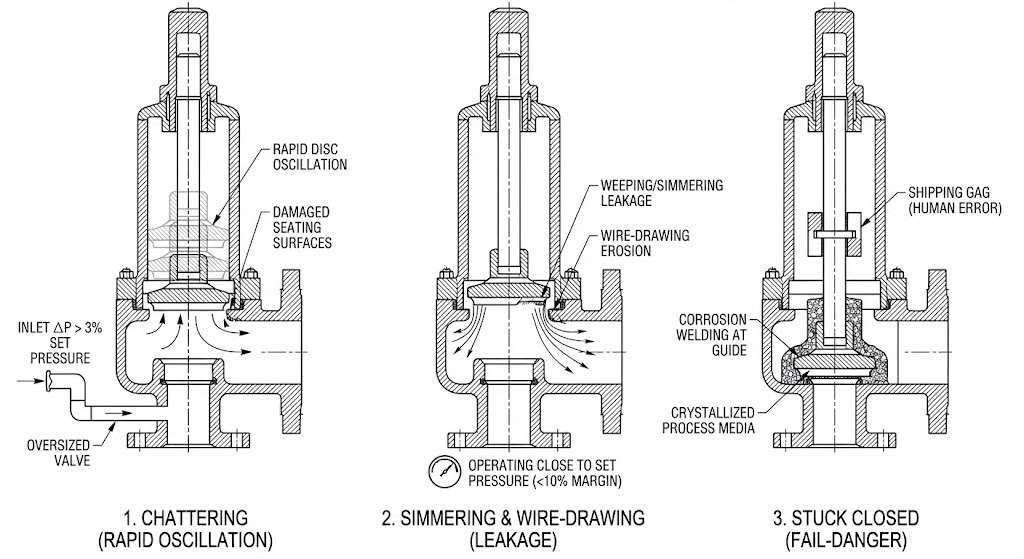
Destroys seating surfaces. Root Cause: Inlet piping pressure drop exceeds 3% of set pressure, or the valve is grossly oversized (>20% rated capacity).
Simmering and Wire-DrawingWeeping below set pressure. Root Cause: Operating too close to set pressure (<10% margin).
Stuck Closed (Fail-Danger)Root Cause: Corrosion welding disc to guide, or crystallized process media. Shipping gags left installed are a frequent human error cause.
Optimizing Maintenance Intervals Using As-Received Data
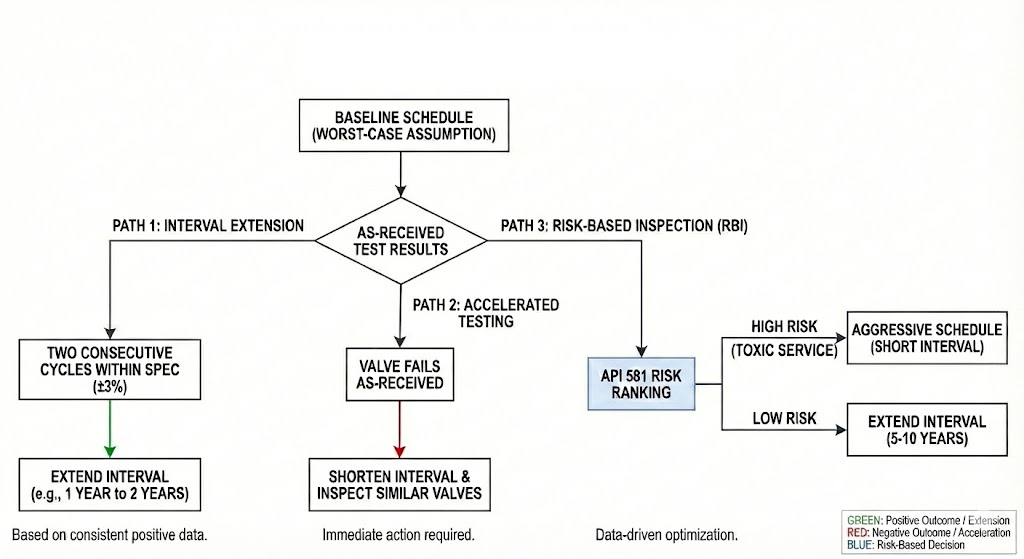
The baseline schedules are worst-case assumptions. You can optimize them:
- Interval Extension: If a valve tests within specification (±3%) for two consecutive cycles, consider extending the interval (e.g., 1 year to 2 years).
- Accelerated Testing: If a valve fails "as-received," immediately inspect all similar valves and shorten the interval.
- Risk-Based Inspection (RBI): Use API 581 to rank valves. High-risk valves (toxic service) need aggressive schedules; low-risk valves can extend to 5-10 years based on data.
Critical Maintenance Mistakes to Avoid
No amount of lapping will fix chattering if inlet piping creates excessive pressure drop. Analyze the system design, not just the valve.
Only lift manually when system pressure is >75% of set pressure. Below this, spring force is too high, and you risk bending the stem or reseating crookedly.
Always transport large valves vertically. Install shipping gags to prevent disc vibration, but verify removal before startup.
Conclusion
Effective pressure relief valve maintenance balances regulatory compliance, reliability, and cost. Start with baseline frequencies, collect rigorous "as-received" test data, and adjust your schedule based on reality. Every successful pop test validates your program; every reliable reseat proves that precision maintenance translates directly to safety and uptime.