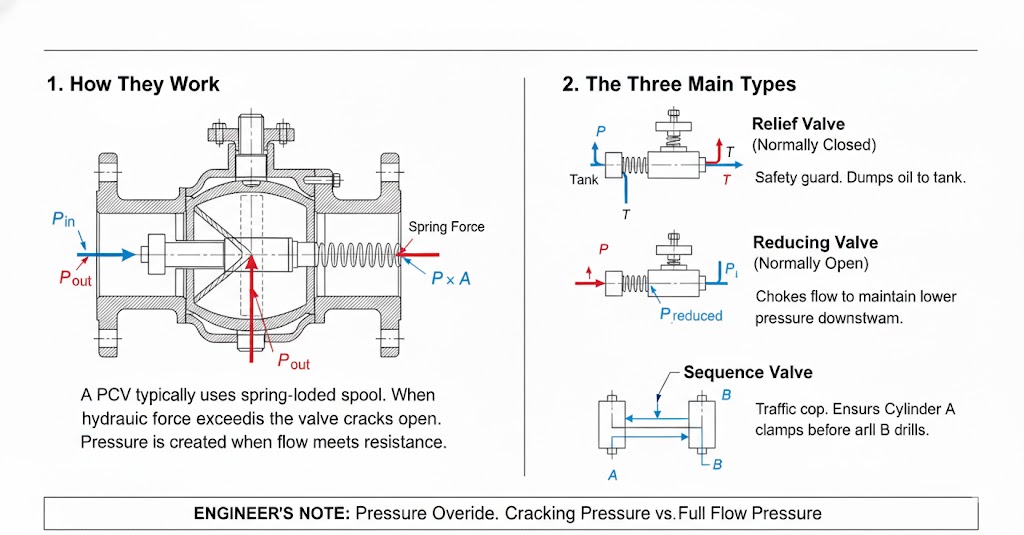
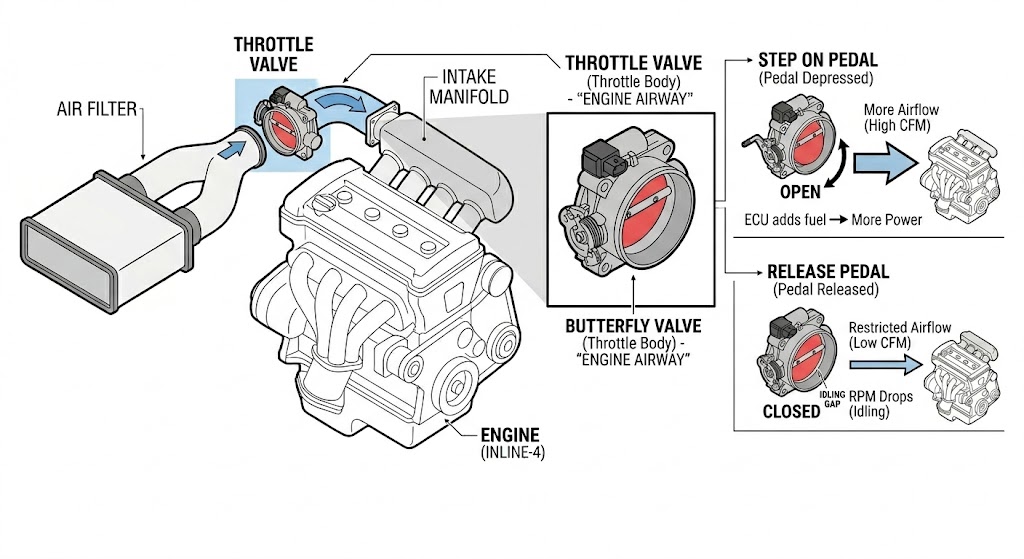
Air flow control valves regulate the movement and volume of compressed air in pneumatic systems. These valves control cylinder speed, manage pressure levels, and direct air flow paths by adjusting internal throttling passages. Unlike hydraulic systems that handle incompressible liquids, air flow control must account for gas compressibility—a characteristic that significantly affects flow calculations and control precision.
For complete selection guidelines and cross-reference documentation on this product line, please consult our hydraulic flow control valves technical guide.
How Air Flow Control Valves Work
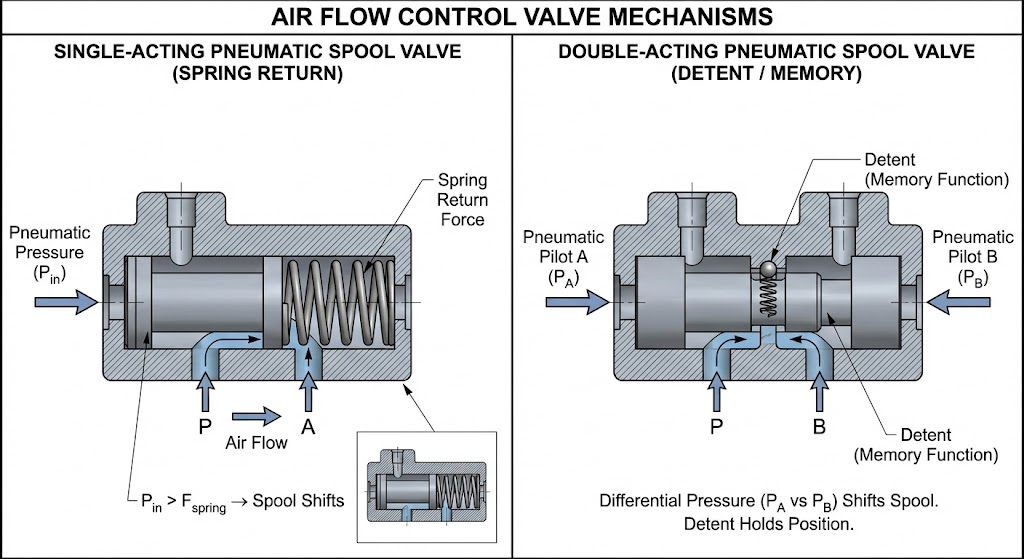
The basic mechanism involves changing the flow area inside the valve body to create a pressure differential (ΔP) between upstream and downstream sections. This pressure drop directly controls gas velocity and mass flow rate.
Inside the valve, a moving component—typically a spool, poppet, or needle—positions itself to vary the cross-sectional area available for air passage. The position of this element depends on force balance. In a typical spool valve, compressed air acts on one end of the spool while a mechanical spring or opposing electromagnetic force pushes from the other end. When pneumatic pressure exceeds the spring’s preload force, the spool shifts and changes the air path configuration.
Single-acting valves use air pressure to drive movement in one direction and rely on spring return. Double-acting valves use air pressure differential to shift the spool between positions without spring assistance, providing a “memory” function that maintains the last commanded position even after power loss.
Fluid Physics: Cv, Kv & Critical Flow
Flow Coefficient: Cv and Kv Values
Engineers use standardized flow coefficients to select valves across different pressure conditions and media types.
- Kv value (Metric): Volume of water (m³/h) flowing with a 1 bar pressure drop. Used in Europe/Global.
- Cv value (Imperial): Flow rate in US gallons per minute (GPM) of 60°F water with a 1 psi pressure drop. Used in North America.
Kv = 0.857 × Cv
Cv = 1.165 × Kv
Critical vs Subcritical Flow
Subcritical flow occurs when downstream pressure (P₂) remains relatively high. Flow rate depends on both upstream and downstream pressure.
Supercritical (choked) flow happens when gas velocity reaches Mach 1 at the valve throat (typically when P₁ ≥ 2P₂). Further reduction in downstream pressure does not increase mass flow rate. This is deliberately used in semiconductor applications to maintain stable flow rates.
Dynamic Response: For high-precision control, parameters like response time (5-15ms for high-end valves) and hysteresis (magnetic remanence) are critical. High-precision valves limit hysteresis to 2-3%, while standard industrial valves may exhibit 7-15%.
Types of Air Flow Control Valves
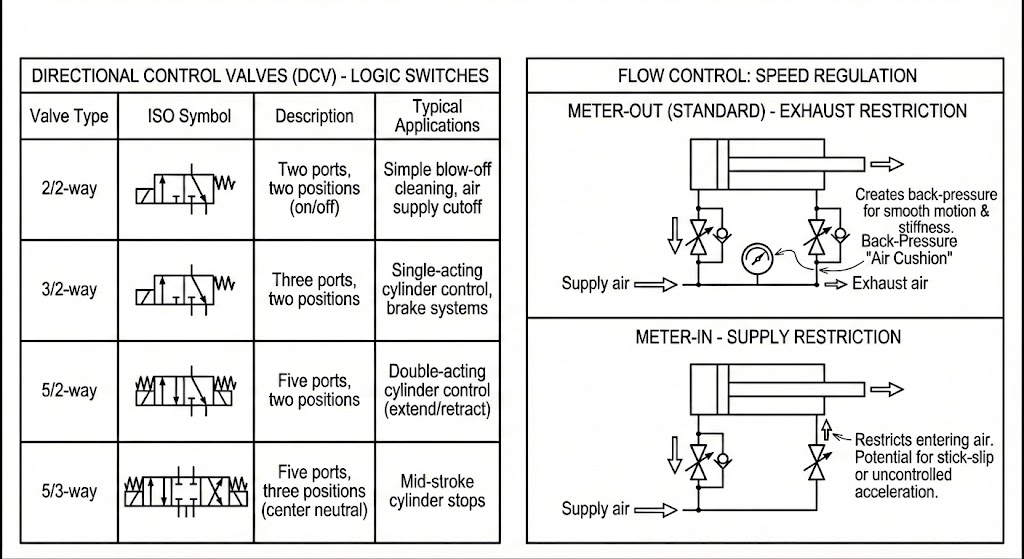
Air flow control valves fall into three functional categories: directional control, flow control, and pressure control.
Directional Control Valves (DCV)
Directional control valves function as logic switches in pneumatic circuits.
| Valve Type | Description | Typical Applications |
|---|---|---|
| 2/2-way | Two ports, two positions (on/off) | Simple blow-off cleaning, air supply cutoff |
| 3/2-way | Three ports, two positions | Single-acting cylinder control, brake systems |
| 5/2-way | Five ports, two positions | Double-acting cylinder control (extend/retract) |
| 5/3-way | Five ports, three positions (center neutral) | Mid-stroke cylinder stops |
Flow Control: Speed Regulation
Meter-Out (Standard): Restricts exhaust gas speed. Creates back-pressure (“air cushion”) that increases system stiffness and smooths piston motion, preventing stick-slip even when loads change.
Meter-In: Restricts air entering the cylinder. Without exhaust back-pressure, the piston may vibrate or accelerate uncontrollably if the load direction matches motion (e.g., downward movement). Only used for single-acting cylinders or constant constant loads.
International Standards and Compliance
ISO 1219 (Symbols): The universal language for schematics. Squares represent positions; arrows show flow.
ISO 5211 (Mounting): Defines flange (F05, F07) and drive shaft dimensions for actuator interchangeability.
ANSI/FCI 70-2 vs API 598 (Leakage):
– FCI 70-2 Class VI: Allows minute leakage (bubbles/min) for soft-seated control valves.
– API 598: Requires “visible zero leakage” for isolation valves.
Note: Never apply FCI 70-2 to safety isolation valves.
ISO 18562 (Biocompatibility): Crucial for medical ventilators, limiting particulate matter and VOC emissions.
Industry-Specific Applications
HVAC: Pressure Independence
Modern smart buildings use Pressure Independent Control Valves (PICV). Unlike traditional pressure-dependent valves, PICVs measure actual airflow and adjust dampers to maintain constant CFM regardless of duct static pressure fluctuations, eliminating system oscillation.
Automotive: Electronic Throttle Control (ETC)
Evolution has moved from separate Idle Air Control (IAC) valves to integrated ETC. Modern drive-by-wire vehicles use the main throttle motor for idle control, eliminating carbon buildup issues associated with bypass channels.
Semiconductor: Ultra-Purity
Wet bench processes require full PTFE/PFA construction or fluoropolymer-lined valves to prevent metal ion contamination. Bellows seals are standard to ensure zero leakage of toxic media.
Digital Transformation: Smart Air Flow Control
Smart Positioners: Enable one-touch auto-calibration and online friction analysis. By monitoring the drive current vs. displacement, they can detect sticky valves before seizure occurs.
Partial Stroke Testing (PST): In safety systems, PST commands ESD valves to move 10-20% without disrupting production. This verifies the valve isn’t jammed, significantly reducing the Probability of Failure on Demand (PFDavg).
IO-Link: The wiring revolution. Replaces parallel wiring bundles with a single 3-conductor cable, transmitting real-time process data (pressure, flow) and event data (coil overheating) to the PLC.
Maintenance and Market Outlook
Troubleshooting Common Failures
| Failure Mode | Symptoms | Common Causes |
|---|---|---|
| External leakage | Audible hissing | Seal aging, improper torque |
| Internal leakage | Airflow at exhaust when closed | Worn spool seals, debris |
| Stiction | Sluggish/Jerky response | Varnish buildup, dried lubricant |
| Coil burnout | No magnetic force | Stuck spool causing high inrush current |
2025-2034 Market Outlook
The market is projected to reach approx. $16.27 billion by 2034. Key trends include a shift towards smart valves (driven by semiconductor and wastewater demand) and supply chain resilience. Manufacturers are facing a paradox where “smarter” valves are more vulnerable to semiconductor shortages, necessitating new strategies in nearshoring and component sourcing.