




If the hydraulic system is the body, the Axial Piston Pump is the heart. From 30-ton excavators to precise aerospace flight controls, this component is chosen for one reason: Power Density. But looking at a 2D engineering drawing can be confusing. How does a spinning shaft create linear pumping motion? What actually changes when you "adjust the flow"?
This guide breaks down the Axial Piston Pump Diagram into its core mechanical anatomy, explains the physics of the swashplate, and decodes the ISO symbols you'll see on hydraulic schematics.
Anatomy of an Axial Piston Pump (The Exploded View)
To understand the function, we must first identify the parts. In a standard "Swashplate" design (like the Rexroth A10VSO or Danfoss H1P series), the components are arranged coaxially.
Key Components Legend:- Drive Shaft: Connects the pump to the motor (electric or diesel). It rotates the Cylinder Block.
- Cylinder Block (Barrel): The rotating "revolver" that holds the pistons. It usually has an odd number of holes (7, 9, or 11) to reduce flow pulsation and noise.
- Pistons: The pumping elements. They move in and out of the cylinder block.
- Slipper Pads (Shoes): The "feet" of the pistons. They slide against the stationary Swashplate.
- Swashplate (Cam Plate): An angled surface that determines the stroke length of the pistons. In variable pumps, this part tilts; in fixed pumps, it is rigid.
- Retainer Plate: Keeps the slipper pads pressed against the swashplate during the intake stroke.
- Valve Plate (Port Plate): The stationary interface at the back. It has two kidney-shaped slots: one for Intake (Suction) and one for Discharge (Pressure).
Working Principle: The Swashplate Angle
The magic of the axial piston pump lies in the conversion of rotary motion into reciprocating linear motion.
The Cycle Step-by-Step:- Rotation: The Drive Shaft spins the Cylinder Block. The Pistons spin with it.
- The Angle: Because the Swashplate is tilted at an angle (\( \alpha \)), the pistons are forced to slide in and out of the barrel as they rotate.
- Intake Stroke (0° to 180°): As a piston moves "downhill" on the swashplate, it pulls out of the barrel, creating a vacuum. Oil is sucked in through the Valve Plate's intake slot.
- Discharge Stroke (180° to 360°): As the piston rides "uphill," it is pushed back into the barrel. This compresses the oil and forces it out through the discharge slot.
The pistons create flow, but they do not create pressure. Pressure is only created when the flow meets resistance (a load).
Variable Displacement: Controlling the Flow
Why are piston pumps preferred over gear pumps? Controllability. You can change the flow rate without changing the engine speed. The flow rate (\( Q \)) depends on the piston stroke (\( S \)), which depends on the Swashplate Angle (\( \alpha \)).
$$ Q \propto \tan(\alpha) $$- Maximum Angle (\( \approx 18^\circ \)): The pistons travel their full stroke. Maximum Flow.
- Reduced Angle: The stroke shortens. Partial Flow.
- Zero Angle (Vertical): The pistons spin but do not move in or out. Zero Flow (Idling), even though the engine is running full speed.
- Negative Angle (Over Center): Used in Closed Loop systems. The flow direction reverses, allowing a hydraulic motor to reverse direction without a valve.
Swashplate vs. Bent Axis Design
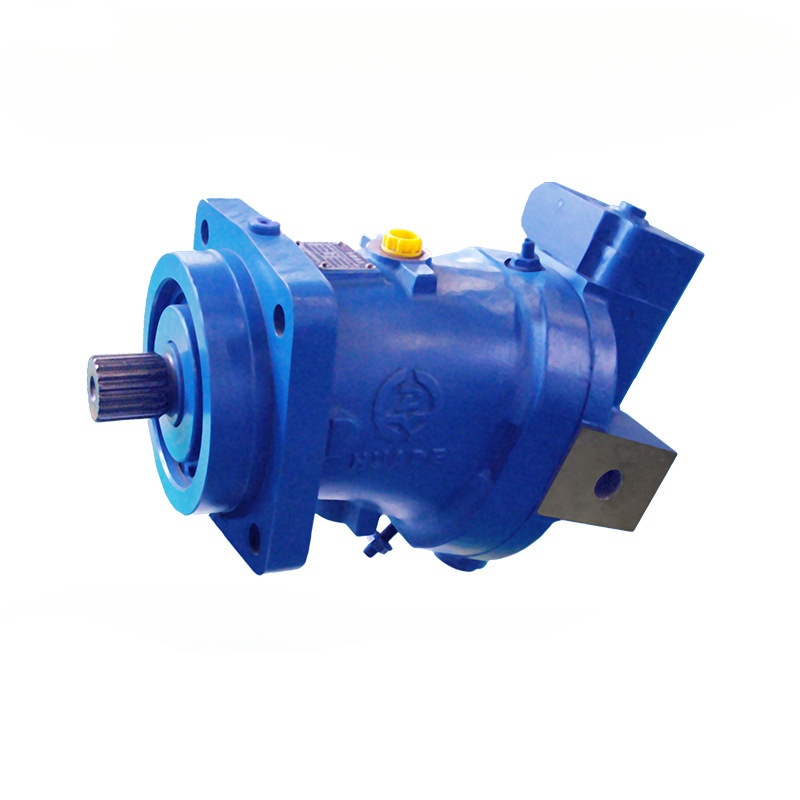
When searching for diagrams, you might see a "bent" pump that looks like a banana. This is the Bent Axis design.
| Feature | Swashplate Design | Bent Axis Design |
|---|---|---|
| Geometry | Shaft and Cylinder Block are In-Line. | Shaft and Cylinder Block are at an Angle. |
| Forces | Pistons rely on Slipper Pads. | Pistons connect directly via Ball Joints. |
| Max Angle | Limited (\( \approx 18-21^\circ \)). | Higher (\( \approx 40^\circ \)). |
| Efficiency | Good. Compact shape. | Best. Handles higher pressures/torque. |
| Application | General Industrial, Mobile. | Heavy Duty Motors, Truck Hydraulics. |
Decoding the Hydraulic Symbol (ISO 1219)
For system engineers, the internal diagram matters less than the schematic symbol.
- The Circle: Represents a rotary pump/motor.
- The Triangle: Solid and pointing OUT means it pumps hydraulic fluid out (Pump).
- The Arrow through the Circle: This is the most critical part. It indicates Variable Displacement. If the arrow is missing, it is a Fixed Displacement pump.
Piston pumps always leak internally for lubrication. This line shows the leakage draining back to the tank. Never block this port, or the shaft seal will blow out immediately due to internal pressure buildup!
The Axial Piston Pump is a masterpiece of tribology and geometry. The Pistons provide the muscle, the Swashplate provides the control, and the Valve Plate directs the traffic.