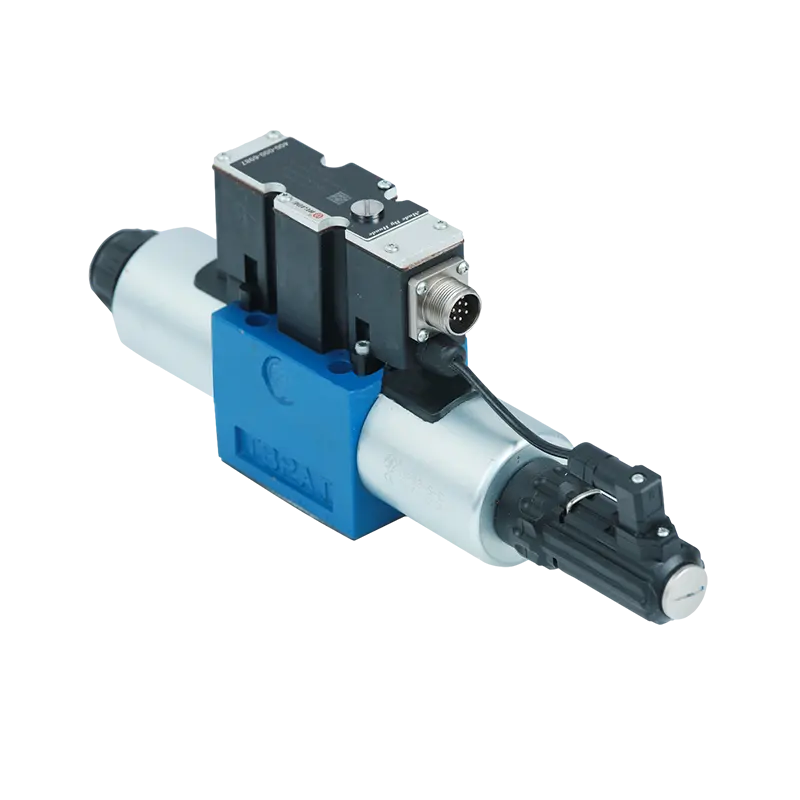





Are you trying to extend a cylinder but it won’t budge? Or maybe you are designing a new machine and wondering, "Do I need a 5/2-way or a 5/3-way valve?"
You are in the right place. The Air Cylinder Control Valve (also known as a Directional Control Valve or Pneumatic Solenoid Valve) is the brain of your pneumatic system. It tells the cylinder when to move, where to go, and how fast to get there. Choosing the wrong one can mean a machine that crashes, stalls, or creates dangerous safety hazards. This guide covers everything from basic Directional Control to Speed Regulation.
Part 1: Directional Control (Getting the Cylinder to Move)
The most common reason you are here is to make a cylinder extend and retract. The type of valve you need depends entirely on the type of cylinder you have.
1. For Single-Acting Cylinders (Spring Return)
The Problem: Your cylinder has only one air port. Air pushes it out, and a spring pushes it back in.
The Solution: You need a 3/2-Way Valve (3 Ports, 2 Positions).
The Problem: Your cylinder has two air ports. You need air to push it out and air to pull it back.
The Solution: You need a 5/2-Way Valve (5 Ports, 2 Positions).
| Cylinder Type | Required Valve | Ports / Positions | Best Application |
|---|---|---|---|
| Single-Acting (Spring Return) | 3/2-Way Valve | 3 Ports / 2 Pos | Clamps, grippers, simple ejectors. Energy efficient. |
| Double-Acting (No Spring) | 5/2-Way Valve | 5 Ports / 2 Pos | Pushers, sliding gates, lifting arms. Most common. |
| Double-Acting + Stop | 5/3-Way Valve | 5 Ports / 3 Pos | Hoists or safety doors where the cylinder must freeze if power is lost. |
Part 2: Speed Control (Regulating Velocity)
A standard solenoid valve is binary: it's either fully open or fully closed. If your cylinder is slamming hard (the "Bang-Bang" effect), you need a Flow Control Valve.
To get smooth, steady motion, you should almost always restrict the air leaving the cylinder, not the air entering it. If you restrict air entering (Meter-In), the cylinder will be "spongy" and jerky because air is compressible.
Look for "Banjo" style flow controls that screw directly into the cylinder ports. They are compact and have a built-in check valve to ensure you are only throttling the exhaust air.
Part 3: Voltage & Actuation (How to Switch It)
Once you know the mechanical type (3/2 or 5/2), you need to choose how to trigger it.
- Solenoid (Electrical): The industry standard. 24V DC is safest for PLC control; 110V/220V AC is common in older systems.
- Manual (Lever/Button): Good for testing jigs or simple tools. No electricity required.
- Air Pilot: Uses an air signal to switch. Essential for ATEX (explosive) zones.
Part 4: Frequently Asked Questions (FAQ)
Q: Can I use a 5/2 valve on a single-acting cylinder?A: Technically yes, by plugging one output port. But it's wasteful. Stick to a 3/2 valve.
Q: What is "\(C_v\)" or "\(K_v\)" Factor?A: This measures flow capacity. A 1/8" port valve (\(C_v \approx 0.2\)) is good for grippers. A 1/2" port valve (\(C_v \approx 2.5\)) is needed for large 4-inch bore cylinders.
This is a classic trick! 90% of the time, the valve is fine. The seal inside your cylinder is worn out. Air is bypassing the cylinder piston, traveling back up the return line, and leaking out of the valve's open exhaust port. Test your cylinder before replacing the valve.
Ready to Select?
Step 1: Check your cylinder labels (Single vs Double acting).
Step 2: Decide on voltage (24V DC is safest).
Step 3: Don't forget Flow Controls if you need smooth motion.
Do you have a specific cylinder bore size? Let me know, and I can recommend the correct port size (NPT/BSP) to prevent air starvation.