




If you are designing a high-pressure hydraulic system (above 300 bar), you are likely looking at an Axial Piston Pump. Unlike gear or vane pumps, axial piston pumps offer the unique ability to vary displacement on the fly, making them the standard for efficient mobile hydraulics and precise industrial control.
But once you open a catalog from Rexroth, Parker, or Danfoss, you are faced with a critical choice: Swash Plate or Bent Axis? This guide breaks down the mechanical differences, efficiency profiles, and control strategies to help you select the right architecture for your application.
Classification by Mechanical Architecture
The primary distinction lies in how the pistons are driven to create stroke.
A. Swash Plate Design (In-Line)This is the most common type found in industrial power units and mobile hydrostatic transmissions.
- Mechanism: The cylinder block turns with the drive shaft. The pistons are held against a stationary, angled plate (the Swash Plate) by slipper pads. As the block rotates, the angle of the plate forces the pistons in and out.
-
Variable Displacement: By mounting the swash plate on a yoke, you can change its angle (\( \alpha \)).
- \( \alpha = 0^\circ \): Zero flow (Idling).
- \( \alpha = \text{Max} \): Maximum flow.
- Key Advantage: Through-Drive Capability. Since the drive shaft and cylinder block are coaxial, the shaft can pass all the way through the back of the pump. This allows you to mount a second pump (e.g., a gear pump for pilot oil) on the rear, saving PTO space.
Known for ruggedness and high efficiency, these are the "heavy lifters" of the hydraulic world.
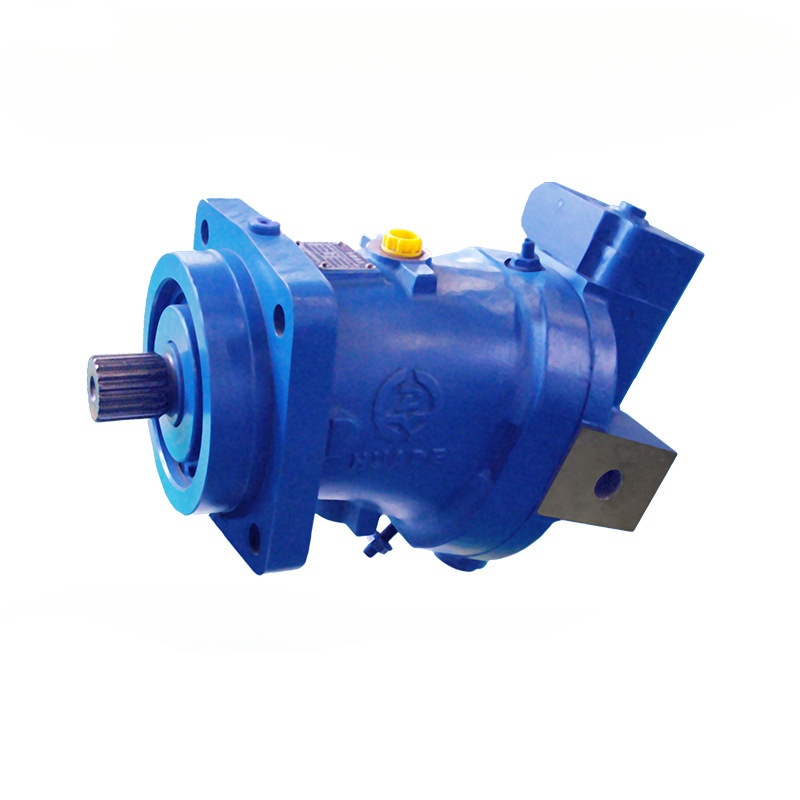
- Mechanism: The cylinder block is mounted at a fixed (or variable) angle relative to the drive shaft. The pistons are directly connected to the drive shaft flange by ball joints.
- Efficiency: Because the pistons do not rely on a slipper pad sliding against a plate (no side load), mechanical efficiency is significantly higher than swash plate designs.
- Key Advantage: High Pressure & Suction. They are more robust against contamination and can often run at higher self-priming speeds.
Technical Comparison: Swash Plate vs. Bent Axis
Use this decision matrix for your commercial investigation.
| Feature | Swash Plate (In-Line) | Bent Axis | Winner |
|---|---|---|---|
| Overall Efficiency | Good (90-94%) | Excellent (93-97%) | Bent Axis |
| Through-Drive (Tandem) | Yes (Standard) | No (Rare/Complex) | Swash Plate |
| Space Envelope | Long & Cylindrical | "L" Shaped / Angular | Depends |
| Self-Priming Speed | Moderate | High | Bent Axis |
| Cost | Moderate | High | Swash Plate |
| Contamination Tolerance | Low (Slipper pads sensitive) | Moderate | Bent Axis |
Need to mount multiple pumps in a line? Choose Swash Plate.
Need a robust motor/pump for a dirty, high-shock environment (like a forestry head)? Choose Bent Axis.
Classification by Displacement (Control Strategy)
Once you pick the mechanical type, you must choose the control logic. This is where the energy savings happen.
A. Fixed DisplacementThe angle is fixed at the factory. Output flow is strictly proportional to RPM. Best for simple motor circuits or fan drives.
B. Variable Displacement (The Industry Standard)- Pressure Compensated (PC): Maintains a set pressure (e.g., 250 bar). If the system reaches this, the pump "de-strokes" to zero flow to save energy. Common in clamping circuits.
- Load Sensing (LS): Monitors actual load pressure via feedback line. Adjusts flow to maintain constant pressure drop. Standard for Excavators and Cranes.
- Horsepower Limiting (Torque Control): Automatically reduces flow as pressure rises to prevent stalling the engine. Used in wheel loaders.
Summary & Selection Advice
For Industrial HPU: Stick to Variable Swash Plate Pumps (e.g., Rexroth A10VSO). They are quiet, precise, and allow pump stacking.
For Mobile Equipment (Main Hydraulics): Use Load-Sensing Swash Plate Pumps. Energy efficiency is critical.
For High-Power Hydrostatic Drives: Consider Bent Axis units (e.g., Rexroth A2FM) for motors due to unmatched starting torque and efficiency.