

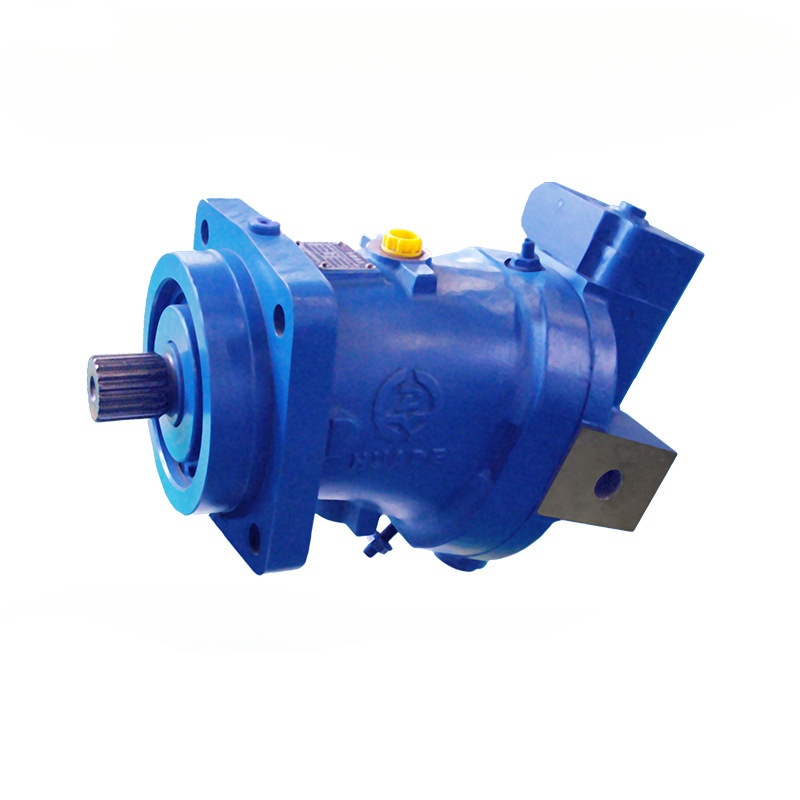



If you type "Piston Motor" into Google Images, you get a confusing mix of results. Half the pictures are V8 engines from a muscle car; the other half are shiny, cylindrical metal lumps used in heavy machinery. If you are a student, the car engine is likely what you are looking for. But if you are an engineer, a procurement manager, or a mechanic dealing with heavy equipment, you are looking for the hydraulic actuator.
In my 20 years designing hydraulic circuits, I’ve seen this confusion lead to ordering errors more than once. So, let’s clear the air immediately:
- Piston Engine (ICE): Burns fuel to create rotation (Chemical Energy \(\rightarrow\) Mechanical Energy).
- Piston Motor (Hydraulic/Pneumatic): Uses high-pressure fluid to create rotation (Fluid Energy \(\rightarrow\) Mechanical Energy).
Today, we are focusing on the latter: the Hydraulic Piston Motor. This is the heavyweight champion of the industrial world. When you see an excavator crawling through mud or a crane lifting 50 tons, a piston motor is doing the heavy lifting.
The Core Concept: How It Works
At its simplest level, a hydraulic piston motor is a pump running in reverse. Instead of an electric motor spinning a shaft to push oil (pump), we force high-pressure oil into the motor to spin the shaft. Here is the physics:
- High-pressure oil enters the cylinder block.
- The oil pushes against a series of internal pistons.
- Because of the motor's geometry (using a Swashplate or a Bent Axis), that linear push is converted into rotational torque.
- The shaft turns.
Why do we use them? Efficiency. Piston motors offer the highest Volumetric Efficiency (95%+) of all hydraulic motors. Unlike Gear or Vane motors, which leak internally as pressure rises, piston motors get tighter and stronger the harder you work them.
The Two Titans: Axial vs. Radial Piston Motors

You cannot just order a "Piston Motor." You have to choose between two completely different architectures. This is the most common decision point I help my clients navigate.
1. Axial Piston Motors (The Speed Demons)In this design, the pistons are arranged parallel to the driveshaft, like bullets in a revolver cylinder.
- Mechanism: A Swashplate (an angled disc) controls the stroke. As the cylinder block rotates, pistons slide along this angled plate to create rotation.
- Superpower: Variable Displacement. By changing the swashplate angle, you can change speed and torque on the fly.
- Best For: High-speed applications (winch drives, fan drives, propulsion).
Here, the pistons are arranged perpendicularly to the shaft, radiating outward like the spokes of a wheel.
- Mechanism: Pistons push outward against an eccentric cam ring.
- Superpower: Low Speed, High Torque (LSHT). No gearbox needed. Massive torque from 0 RPM.
- Best For: "Track Drives" on excavators, injection molding screws, heavy conveyors.
Technical Comparison: The "Cheat Sheet"
If you are sourcing components, copy this table. It highlights why you would pay 5x more for a Piston Motor compared to a standard Gear Motor.
| Feature | Gear Motor | Vane Motor | Axial Piston Motor | Radial Piston Motor |
|---|---|---|---|---|
| Pressure Rating | Low (Max 250 bar) | Medium (Max 280 bar) | High (350-450 bar) | Very High (450+ bar) |
| RPM Range | High (600-3000) | Medium | Very High (up to 5000+) | Low (1-500) |
| Overall Efficiency | 70-80% | 75-85% | 90-95% | 92-96% |
| Start-Up Torque | Poor | Medium | Good | Excellent |
| Cost Index | $ | $$ | $$$ | $$$$ |
Why "Start-Up Torque" Matters
Imagine a winch holding a 10-ton load. You want to lift it. A Gear Motor leaks internally when stopped and might not generate enough "Breakaway Torque" to move the load. It might even slip.
A Radial Piston Motor has almost zero internal leakage and high mechanical leverage. It delivers near-maximum torque the instant oil hits it. If your application involves starting under heavy load, you must use a piston motor.
Maintenance: The Achilles' Heel
Piston motors are engineering marvels, but they are divas about one thing: Cleanliness. Because internal clearances are machined to micron-level tolerances, they have zero tolerance for dirt.
The Danger: If your oil cleanliness code drops below ISO 4406 18/16/13, particles will scratch the soft bronze valve plate. Once scratched, efficiency drops, case drain flow increases, and torque is lost.
Summary & Next Steps
It is the premium choice for converting fluid power into rotary motion. Choose Axial Piston if you need speed and variability. Choose Radial Piston if you need brute force and low speed.
If you are replacing a motor, check the Case Drain line.
Piston motors always have a third line (besides Pressure and Tank) called the Case Drain. If you block this port or plumb it incorrectly, the internal pressure will blow the shaft seal out in seconds. It is a messy $2,000 mistake. Check your plumbing diagram twice.