




In the world of piping and fluid control, few questions trigger as much debate between maintenance technicians and design engineers as this one: "Can I use this gate valve to throttle the flow?"
Unless you are dealing with a highly specialized exception, using a standard gate valve for throttling is a recipe for system failure. It’s like trying to drive a nail with a screwdriver—you might get it done, but you’ll ruin the tool and damage the project.
In this guide, we’ll dive into the fluid dynamics behind why this is a bad idea, the physical damage it causes, and the correct valves you should be using instead.
The Core Rule: Why "No" Means No
A standard gate valve is designed for one purpose only: Isolation. It is an On/Off device. According to engineering standards like API 600, gate valves are engineered to operate in only two positions:
- Fully Open: To allow full flow with minimal pressure drop.
- Fully Closed: To provide a leak-tight seal and stop the flow completely.
When you leave a gate valve in a "half-open" position to regulate flow, you force it to function outside its design parameters, triggering destructive physical forces inside the valve body.
The 3 Hidden Dangers of Throttling with a Gate Valve
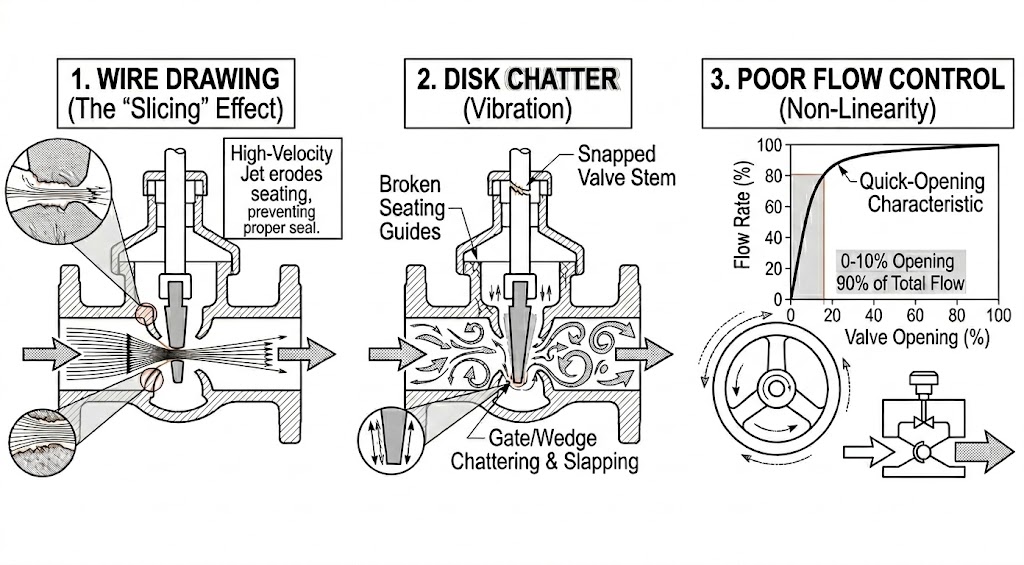
Why exactly does a gate valve fail when used for throttling? It’s not just a rule of thumb; it’s physics.
1. Wire Drawing (The "Slicing" Effect)When a gate valve is cracked open (e.g., 10% open), the fluid is forced through a tiny, crescent-shaped slit at extremely high velocity.
- The Result: This high-speed jet acts like a water jet cutter. It erodes the metal on the seating surfaces and the gate itself. This phenomenon is called "Wire Drawing."
- The Consequence: When you finally try to close the valve completely, it won't seal. The eroded "scratches" will allow fluid to leak through forever.
The gate (or wedge) inside the valve is held loosely by the stem to allow it to seat properly. It is not rigidly guided throughout its entire travel. When fluid rushes past a partially open gate, turbulence creates vortex shedding, causing the gate to "chatter" or slap violently against the seat guides. This can destroy internal guides and even snap the valve stem.
3. Poor Flow Control (Non-Linearity)Gate valves have "Quick-Opening" flow characteristics. Research shows that nearly 90% of the flow occurs in the first 10-20% of opening. This means you have almost zero control—a tiny turn of the handwheel results in a massive surge of flow.
Comparison: Gate Valve vs. Throttling Valves
If you need to control flow, choose the right tool. Here is how gate valves compare to true throttling valves.
| Valve Type | Throttling Suitability | Best Application | Flow Characteristic |
|---|---|---|---|
| Gate Valve | ❌ PROHIBITED | Isolation (On/Off) only. | Quick-Opening (Poor control) |
| Globe Valve | ✅ EXCELLENT | Precise regulation (steam, gas, liquid). | Linear (Precise control) |
| Needle Valve | ✅ EXCELLENT | Fine instrumentation adjustments. | Fine Linear |
| Butterfly Valve | ⚠️ FAIR | Large diameter, low-pressure (HVAC). | Modified Equal Percentage |
| Ball Valve | ⚠️ POOR | Isolation. Throttling wears seats rapidly. | Quick-Opening |
The "Exception": When CAN You Use a Gate Valve to Throttle?
Is there ever a case where the answer is "Yes"? Only if you buy a specially engineered Control Gate Valve.
1. V-Port Knife Gate ValvesUnlike a standard wedge gate, these valves have a gate with a V-shaped notch cut into the bottom. The V-shape creates a linear relationship between opening and flow rate. They are essential in paper pulp and mining slurry applications where globe valves would clog.
2. Orifice Gate ValvesUsed specifically for dry bulk solids (powders, pellets). The sliding plate has a hole that aligns with the flow.
Summary: Engineer’s Advice
If you are standing in front of a standard brass or steel gate valve right now, do not use it to control flow. If you do it once for 5 minutes during an emergency, it might survive. If you leave it half-open permanently, you will be replacing that valve within months due to seat leakage or stem failure.
Do you need help selecting the correct Globe Valve or Control Valve for your specific pressure and flow requirements? I can help you size the valve if you provide your pipe diameter and media type.