




If you are in a rush and need a "Yes" or "No" answer, here it is:
- For a standard ball valve: No. Do not do it. You will ruin the valve in days, sometimes hours.
- For a V-Port ball valve: Yes. They are specifically designed for this.
But you aren't here just for a one-word answer. You are likely staring at a plumbing diagram or a budget spreadsheet, wondering, "Why can't I just crack this ball valve open 20% to control the flow? It’s cheaper and smaller than a globe valve." I’ve heard this question a thousand times. Here is the engineering reality.
The "Wire Drawing" Effect: How to Kill a Valve
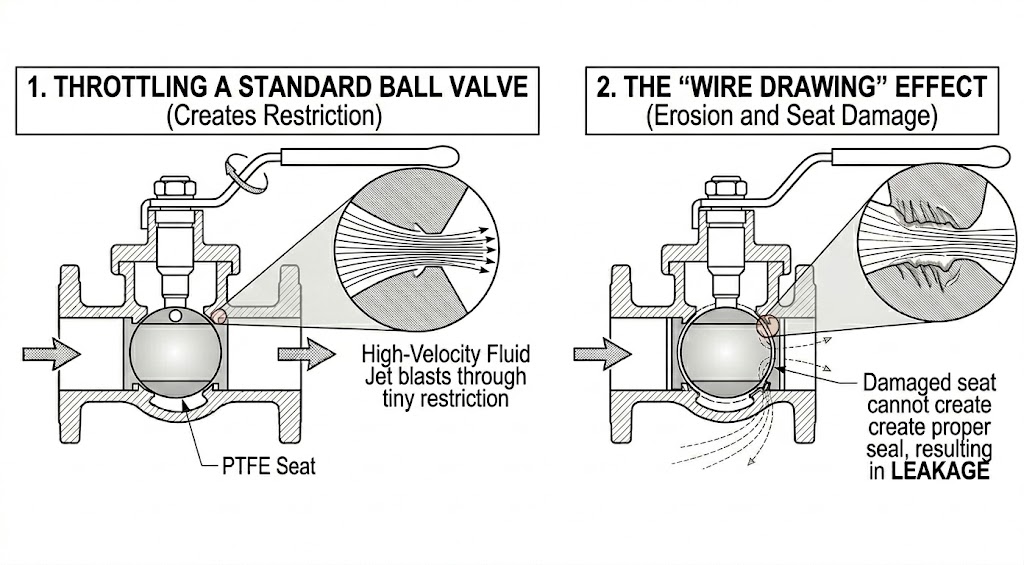
Standard ball valves are designed for one job: Isolation (On/Off). When you partially close a standard round-port ball valve, you create a tiny, crescent-shaped opening between the ball and the soft seat (usually PTFE).
The Physics of Failure:
- Velocity Spike: According to Bernoulli’s principle, forcing fluid through that tiny restriction causes velocity to skyrocket.
- Erosion: This high-velocity jet acts like a water jet cutter, blasting against the soft valve seat.
- The Result: "Wire Drawing"—grooves cut into the seat material. The valve will leak the next time you try to close it.
The Hidden Enemy: Cavitation and Noise
If you are throttling liquids, standard ball valves have a Low Pressure Recovery Factor (\(F_L\)). Throttling creates a drastic pressure drop, forming vacuum bubbles.
When those vacuum bubbles collapse downstream, they create violent micro-shockwaves. It sounds like gravel rattling inside your pipes and pits the metal ball, leading to structural failure.
The Exception: The "V-Port" Ball Valve
Remember when I said "Yes" earlier? That applies only if you buy a specialized V-Port (Segmented) Ball Valve. These have a V-shaped notch cut into the ball (usually \(30^{\circ}\), \(60^{\circ}\), or \(90^{\circ}\)).
- Linear Flow: The V-shape creates an "Equal Percentage" flow characteristic for precise control.
- Shearing Action: The sharp edge acts like a scissor, making them excellent for slurries or pulp that would clog a Globe Valve.
Cheat Sheet: Ball Valve vs. Globe Valve vs. V-Port
If you are selecting a valve right now, use this table based on ISA 75.01 standards.
| Feature | Standard Ball Valve | Globe Valve | V-Port Ball Valve |
|---|---|---|---|
| Primary Function | Isolation (On/Off) | Throttling / Control | High-Performance Control |
| Flow Characteristic | Quick Opening (Non-linear) | Linear or Modified | Equal Percentage |
| Damage Risk | High (Wire Drawing) | Low | Low (Hardened seats) |
| Best Application | Emergency Shut-off | Clean fluids, precision | Slurries, High-flow |
| Cost Index | $ | $$ | $$$ |
My Final Recommendation
For Temporary/Garden Use: You can "crack" a ball valve for a few hours. It won't explode.
For Industrial/Process Use: Do not use standard ball valves. You will destroy the seats. Use a Globe Valve for clean fluids, or a V-Port Valve for dirty fluids/high turndown requirements.
If you suspect your current system is suffering from Cavitation or Wire Drawing, inspect the valve downstream. If you see "pitting" on the metal or grooves on the seat, it's time to swap that ball valve for a proper Globe or Needle valve.