If you look at any hydraulic schematic, you will almost certainly find a throttle valve. It is the bread and butter of hydraulic control. But after 20 years in the field, I still see young engineers getting confused about what this component actually does versus what they think it does.
Let’s keep it simple. Think of a throttle valve like the nozzle on your garden hose. When you twist the nozzle to tighten the stream, you are restricting the opening. The water flows less, and the pressure builds up behind the nozzle.
The Core Function: Creating Resistance
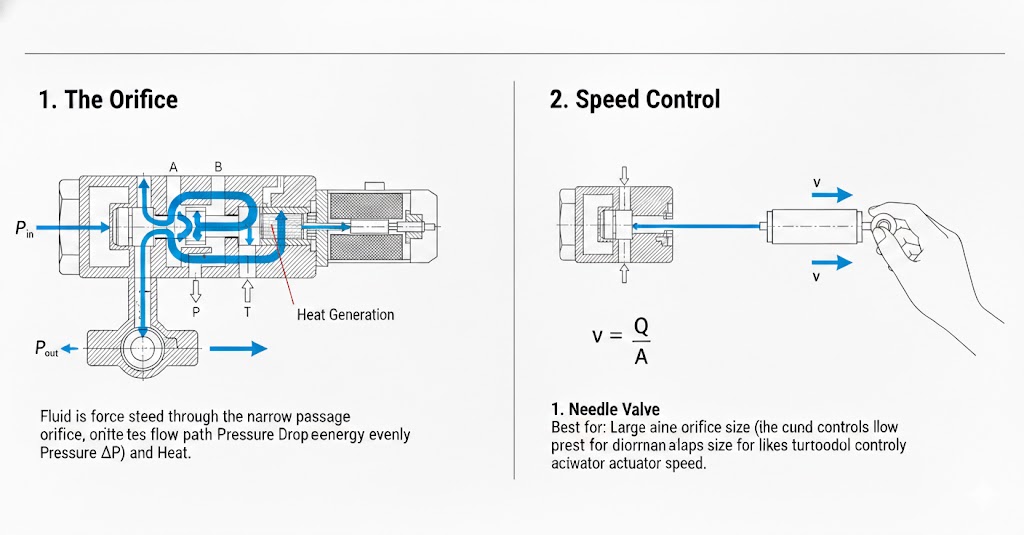
In a hydraulic system, a Throttle Valve is a basic Flow Control Valve. Its job is to create a narrow passage (an orifice) in the pipe. By restricting the flow of oil, we can control how fast a cylinder extends or a motor spins.
A throttle valve doesn’t just “slow things down” by magic. It works on the principle of Fluid Friction. When hydraulic oil is forced through a tiny opening, two things happen:
- Pressure Drop (( Delta P )): The pressure after the valve is lower than the pressure before it.
- Heat Generation: The energy lost to friction turns into heat.
By adjusting the size of this opening, you change the flow rate (( Q )). Since Speed is a function of flow and area:
$$ v = frac{Q}{A} $$
Controlling the flow gives you direct control over the actuator’s speed.
The “Big Trap”: Throttle Valve vs. Flow Control Valve
This is where 90% of mistakes happen. You might see a “Throttle Valve” and a “Flow Control Valve” listed in a catalog. They look similar. They both control speed. But they are not the same.
A simple Throttle Valve is Load Dependent. Imagine driving a car with your foot fixed on the gas pedal:
– On a flat road: You go 60 mph.
– Driving up a steep hill (High Load): You slow down to 40 mph, even though your foot hasn’t moved.
If you need the speed to stay exactly the same regardless of the load (like in a CNC machine), you need a Pressure Compensated Flow Control Valve.
Comparison Table: Which one do you need?
| Feature | Simple Throttle Valve | Pressure Compensated Valve (2-Way) |
|---|---|---|
| Core Mechanism |
Fixed Orifice Just a variable restriction (Needle). |
Variable Orifice + Hydrostat Adjusts automatically to maintain constant (Delta P). |
| Load Sensitivity |
High Speed drops as load increases. |
None Speed remains constant regardless of load. |
| System Efficiency | Higher heat generation. | Better efficiency in variable loads. |
| Typical Use | Forklift lowering, simple clamping. | Conveyor belts, machine tool feeds. |
| Cost | $ (Cheap & Robust) | $$$ (Complex & Sensitive) |
Reading the Map: ISO Symbols
When you are troubleshooting a machine, you need to recognize these symbols instantly.
Variable Throttle
Look for two curved lines clamping a straight line (the flow path). An arrow acts as a slash through it, indicating it is adjustable.
One-Way Throttle (Throttle Check Valve)
This is the most common configuration. It combines a throttle valve with a Check Valve.
- Flow A to B: Check valve blocks the path, forcing oil through the throttle. Speed is controlled.
- Flow B to A: Check valve opens, allowing oil to bypass the throttle completely. (Free Reverse Flow).
Where do we actually use them?
We generally use throttle valves in two main circuit configurations:
- Meter-In Circuit: Restricts oil entering the actuator. Great for lifting loads, but dangerous if the load can run away (like a crane lowering a weight).
- Meter-Out Circuit: Restricts oil leaving the actuator. Creates Back Pressure, which stiffens the system and prevents “stick-slip” or runaway loads. This is the preferred method for most industrial machines.
Engineer’s Advice: Watch Out for “Silting”
Here is a tip you won’t find in basic textbooks. Because throttle valves often have very small clearances, they are prone to Silting. This happens when microscopic particles in your oil get jammed in the valve gap due to the pressure drop.
If your machine runs fine in the morning but the speed starts drifting or the valve gets “stuck” after a few hours, check your oil cleanliness (ISO 4406). A simple throttle valve is robust, but it’s not immune to dirty oil.
Need help selecting the right size valve for your flow rate? I can help you calculate the flow coefficient (( C_v )) required for your system pressure. Just ask!