

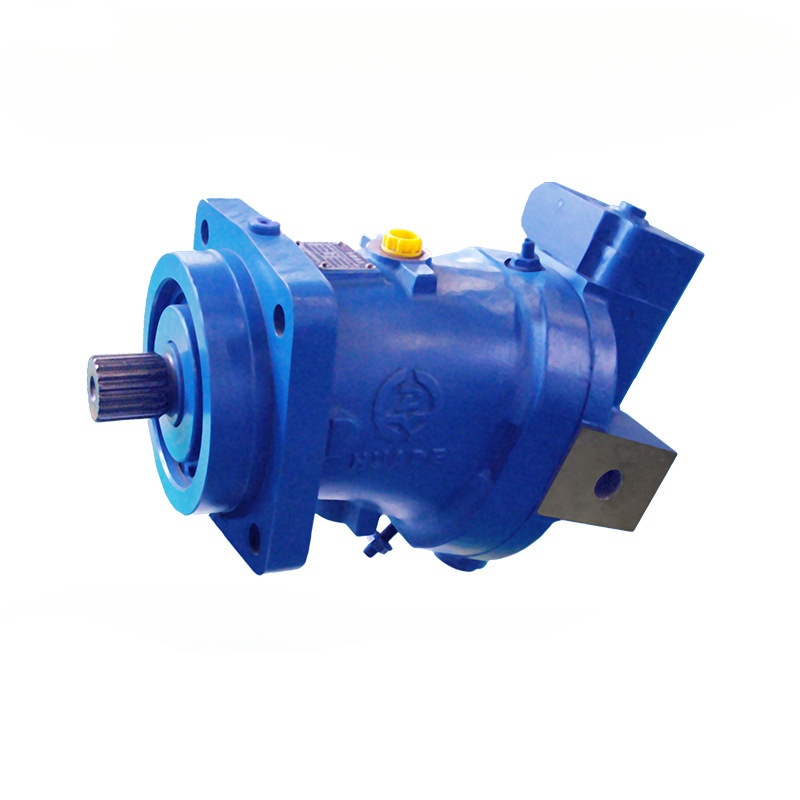



I’ve spent the better part of twenty years getting hydraulic oil under my fingernails and listening to the distinct hum—or the dreaded death-rattle—of industrial machinery. When your machine stops moving or loses power, you aren't just looking for "metal bits." You are looking for a specific axial piston motor part that restores your system's heartbeat. I’ve seen too many managers buy the cheapest aftermarket parts only to watch their motor self-destruct because a tolerance was off by a fraction of a millimeter. You aren't just buying metal; you are buying engineering precision.
The "Map" of Your Axial Piston Motor Parts
When you pull up a parts catalogue for a Rexroth A6VM or a Danfoss Series 90, the exploded view can look like a mess of circles and lines. To simplify it, I always tell my techs to look at the Rotary Group.
This is the core of the motor. It consists of the cylinder block, the pistons, the valve plate, and the slipper pads. If any of these "Big Four" fail, your volumetric efficiency drops through the floor. Most of the parts you find in a seal kit are there to handle the "breathing" of the motor. But the rotary group is where the power conversion happens. If you see deep scratches on the cylinder block face, it doesn't matter how new your seals are; the oil will simply bypass the pistons, and you’ll lose torque.
Critical Wear Components and SymptomsKnowing which axial piston motor part to replace starts with reading the "metal footprints" left behind by wear. Below is a quick reference table I use during teardowns.
| Component Name | Primary Material/Process | Common Failure Symptom | Engineer's Recommendation |
|---|---|---|---|
| Valve Plate | Nitrided Steel (HV 800) | High-pitched whining; loss of speed | Replace if surface "smearing" is visible. |
| Piston & Slipper | SAE 660 Leaded Bronze | "Marbles in a blender" noise | Check "End Play" > \( 0.127 \) mm; replace group. |
| Cylinder Block | Ductile Iron / Bimetal | System overheating; high leakage | Inspect for scoring on the kidney ports. |
| Shaft Seal | Nitrile / Viton | Oil leaking from the drive shaft | Check for high Case Drain pressure. |
The Science of Slipper Pads and "End Play"
In my experience, the slipper pad is the most misunderstood axial piston motor part. These bronze pads "float" on a microscopic oil film against the swash plate. This is called hydrostatic balancing. If your oil is dirty—specifically if your ISO 4406 cleanliness levels exceed 19/17/14—particles get trapped in this film. This leads to silting, which creates a "sandpaper effect" that grinds down the bronze.
One thing I always check is the "End Play." This is the axial gap between the piston ball and the slipper socket. In professional repair shops, we use a dial indicator. If the gap is wider than \( 0.005 \) inches (roughly \( 0.127 \) mm), that slipper is a ticking time bomb. It will eventually "pop" off the ball, leading to what we call "Shoe Separation," which effectively turns the inside of your motor into a metal shredder.
Why Materials Matter: Nitriding and Bronze
When you are sourcing an axial piston motor part, you’ll see a huge price gap between OEM and some aftermarket brands. The difference is often invisible to the eye but obvious to a microscope.
Valve Plate (Nitriding): Quality plates undergo gas nitriding. This process creates a "white layer" on the steel that is incredibly hard—often reaching HV 800 on the Vickers scale. This hardness is what allows the cylinder block to spin against it at 3,000 RPM without welding itself to the plate. Cheap parts often skip the deep nitriding, meaning they might work for a week but will "smear" and fail as soon as the oil gets hot.
Cylinder Block (Ductile Iron/Bimetal): Ductile iron is used because the graphite nodules inside it help absorb vibration. In some high-pressure motors, we use bimetallic blocks where a layer of bronze is permanently fused to the steel face. If you see the steel peeking through that bronze layer, your motor’s internal leakage is already too high to maintain pressure.
Troubleshooting Through the Case Drain
If you want to know if an internal axial piston motor part is failing without taking the motor apart, look at your case drain. Every motor leaks a little bit of oil internally to stay lubricated. This oil exits through the case drain port.
I use a simple rule of thumb for leakage flow (\( Q_{L} \)):
$$ Q_{L} \approx \frac{V_{g} \cdot n}{1000} \cdot (1 - \eta_{v}) $$In this formula, \( V_{g} \) is the displacement, \( n \) is the speed, and \( \eta_{v} \) is the volumetric efficiency. If the flow coming out of that drain line is hot and high-volume, it means the gaps between your pistons and the block, or the block and the valve plate, have opened up.
Maintaining the ISO 4406 Standard
You can buy the best parts in the world, but they won't last if your oil is a mess. I tell my clients that a piston motor is a "filter" that costs $10,000. It will catch every bit of dirt in your system. We target a cleanliness of 18/16/13 for these units.
If you see cavitation damage—which looks like the metal was hit by a miniature shotgun—it means your inlet was restricted or air was getting in. This isn't a part failure; it’s a system failure.
When you buy your next seal kit or rotary group, pay attention to the manufacturer's specs. Check the bronze for a high lead content (like SAE 660) to ensure it can handle dry-start friction. And most importantly, always pre-fill the motor case with clean oil before you turn the shaft. A "dry start" will ruin a new set of parts in under thirty seconds.