




If you typed "throttle butterfly valve" into the search bar, you are likely standing in front of one of two very different problems:
- The Automotive Nightmare: Your car is idling roughly, stalling at red lights, or the "Check Engine" light is mocking you. You are looking for the Throttle Body.
- The Engineering Dilemma: You are a piping engineer wondering if you can use a cheap Butterfly Valve to regulate flow (throttle) instead of buying an expensive Globe Valve.
As an engineer who has spent two decades dealing with both fluid dynamics and greasy engine bays, I can tell you that while the physics are the same (a disc rotating in a tube), the application rules are totally different.
 Guide Contents
Part 1: The Automotive Context
In the automotive world, the "butterfly valve" is the main component of your Electronic Throttle Body (ETB). If you are here because your engine is acting up, you aren't dealing with a valve design flaw; you are dealing with contamination.
Symptoms of a Dirty Butterfly PlateWhen the PCV system recirculates oil vapors, a sticky sludge builds up on the back of the butterfly plate. This ruins the precise airflow gap required for idling.
- Rough Idle: The RPM needle bounces up and down.
- Stalling: Especially when coming to a sudden stop.
- Sticky Pedal: Physical resistance when pressing the gas (cable-driven units).
Many modern throttle bodies (Bosch, Denso) have a special grey sealing coating (Molybdenum) around the edge of the butterfly plate. Do not scrub this off. If you scour it down to bare metal using harsh solvents, you will ruin the air seal, causing a permanent high idle that no amount of ECU "re-learning" can fix.
Use a dedicated "Throttle Body Cleaner" and a soft microfiber cloth. Wipe gently. If you move the butterfly plate manually on an electronic unit, ensure the battery is disconnected to avoid damaging internal gears or TPS calibration.
Part 2: The Industrial Context (Engineering & Selection)
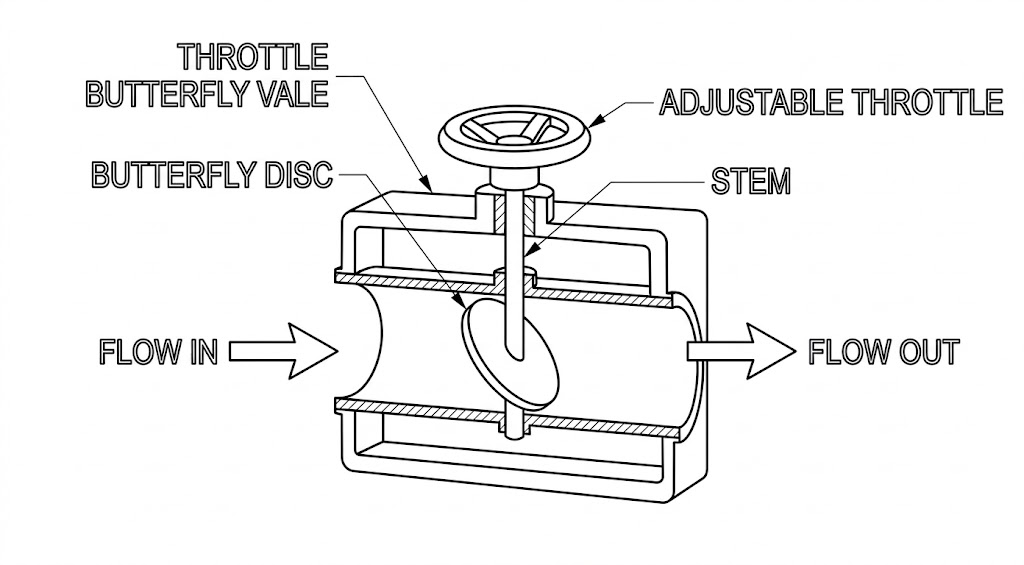
Now, let’s talk to the plant engineers. Can you use a Butterfly Valve for throttling control? The short answer: Yes, but only in the 'Sweet Spot'.
The "Sweet Spot": 15° to 70°Unlike a Globe Valve which has a linear flow characteristic, a standard concentric butterfly valve acts differently:
- 0° to 15° (The Danger Zone): Do not control flow here. Fluid velocity is incredibly high, leading to "Wire Drawing" (erosion).
- 15° to 70° (The Control Range): This is where you can throttle. The valve offers a modified equal-percentage characteristic.
- Above 70° (The Dead Zone): The valve is effectively "full open." A tiny movement of the disc does almost nothing to change the flow rate \(C_v\).
If you use a standard rubber-lined butterfly valve to drop high pressure (high \(\Delta P\)), you are asking for trouble. If pressure drops below vapor pressure, bubbles form and then implode downstream. This sounds like gravel rattling in your pipes and will eat through a stainless steel disc in weeks.
My Advice: If your pressure drop ratio \(\Delta P / P_1\) is high, use a High-Performance Double Offset valve or switch to a Globe valve.
Part 3: Selection Cheat Sheet
If you are trying to convince your boss or client which valve to buy, use this comparison.
| Feature | Standard Butterfly (Concentric) | High-Performance (Double Offset) | Globe Control Valve |
|---|---|---|---|
| Best Use Case | Low-Pressure HVAC Throttling | Moderate Throttling & Pressure | Precision & High Pressure Drop |
| Control Range | Narrow (20° - 60°) | Medium (15° - 70°) | Wide (10% - 90% lift) |
| Cavitation Risk | High | Moderate | Low |
| Cost Index | $ (Very Low) | $$ (Medium) | $$$$ (High) |
A Note on Dynamic Torque
Here is something textbooks often miss. When fluid hits the angled butterfly disc, it acts like an airplane wing, generating lift. This creates Dynamic Torque that tries to close the valve.
When sizing an actuator, do not just look at the breakaway torque. You must account for the dynamic torque at 60° open. If your actuator is undersized, the flow will slam the valve shut, causing a water hammer that can rupture upstream welds.
Final Verdict
Your "throttle butterfly" is likely just dirty. Clean it carefully, watch out for the coating, and reset your ECU. If gears are stripped, replace the assembly.
Stop treating Butterfly Valves as universal control valves. Use them for large lines (DN150+) with low pressure drop. Avoid them for precise control below 20% flow.