




Ever looked at a hydraulic schematic and wondered why a directional valve symbol has two extra parallel lines "squeezing" the box? Or why there is an arrow shooting through the solenoid coil? If you are confused, you are not alone.
As a hydraulic engineer, I have spent twenty years staring at Huade. I can tell you that misreading a Proportional Valve Symbol isn't just a paperwork error. It’s the difference between a machine that runs smoothly and one that oscillates wildly or fails to hold a load. You don't need a PhD in fluid dynamics to read these drawings. You just need to understand the hidden logic of ISO 1219-1.
The Anatomy of the Symbol: What Makes It "Proportional"?

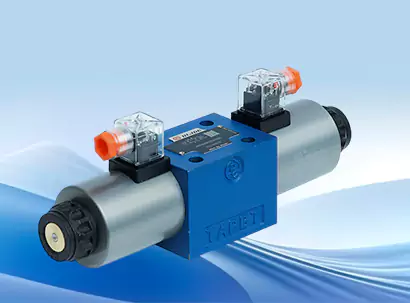
At first glance, a proportional valve looks a lot like a standard 4/3 directional control valve. But there are three specific visual cues—"The Big Three"—that change everything.
1. The Parallel Lines (The "Metering" Lines)This is the most important feature. Look for two horizontal lines running parallel to the top and bottom of the valve spool rectangles. In standard switching valves, these lines don't exist.
In Proportional Directional Control Valves (PDCV), these lines represent the precision V-grooves or U-notches machined onto the valve spool. They tell you the valve doesn't just snap open or closed. It can hover at 10%, 50%, or 99% opening, controlling velocity (flow) as well as direction.
A standard solenoid symbol is just a rectangle with a diagonal slash (Binary: On/Off). A Proportional Solenoid symbol adds a small arrow pointing through that slash.
- The Translation: This coil accepts a variable input signal (usually PWM, 0-10V, or 4-20mA).
- The Physics: Magnetic force changes linearly with current. Do not connect this directly to a 110V relay; it requires a driver card.
Sometimes, you will see a small square box drawn directly on top of the solenoid symbol. This represents an LVDT (Linear Variable Differential Transformer). This isn't just a magnet anymore; it’s a sensor enabling Closed-Loop Control.
Cheat Sheet: Standard vs. Proportional Symbols
If you are scanning a schematic quickly, use this comparison table to identify what you are dealing with.
| Feature | Standard Directional Valve (Switching) | Proportional Directional Valve |
|---|---|---|
| Visual ID | Plain Boxes | Parallel Lines enclosing the boxes |
| Solenoid Symbol | Rectangle with diagonal line | Rectangle with diagonal line + Arrow |
| Spool Movement | Discrete Steps (Left, Center, Right) | Infinite Positioning (Anywhere in between) |
| Flow Logic | Full Flow or No Flow | Metering (Controls flow rate) |
| Control Signal | Digital Output (24V On/Off) | Analog/PWM (e.g., ±10V, 4-20mA) |
Decoding Advanced Features: OBE and Failsafes

Modern systems are getting smarter. The symbols have evolved to show us exactly where the "brains" of the valve are located.
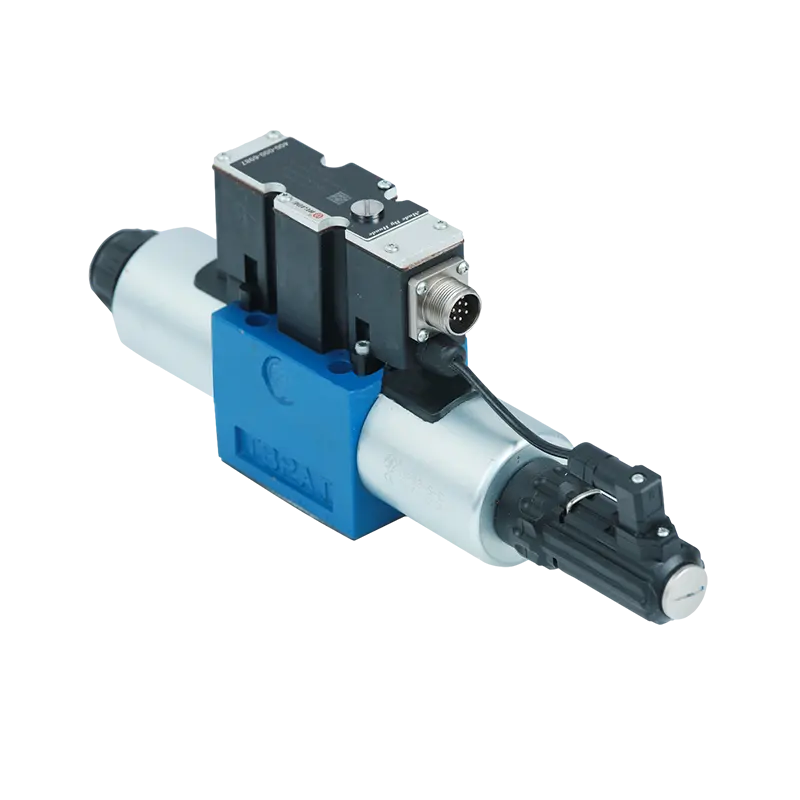
Look for a solid block outline encapsulating the solenoid and a small triangle symbol (amplifier) inside the valve drawing.
- Implication: You don't need an external driver card; you need a 7-pin connector.
- Pin F Warning: Pin F is the "Actual Value Output," allowing you to measure spool position with a multimeter during troubleshooting.
Most valves have 3 boxes. High-end proportional valves (like Rexroth 4WRZ) often show a 4th box separated to the far right or left. This is the Safe Position. If power or the "Enable" signal is lost, a strong spring forces the spool here (usually closing all ports) to determine emergency behavior.
3 Common Mistakes When Reading These Symbols
I have seen seasoned technicians make expensive mistakes by glossing over tiny details.
1. Ignoring the "Y" Port (External Drain)Look closely at the pilot section. Is there a dashed line coming out labeled "Y" leading to the tank? If you plug this port or combine it with a pressurized return line, the backpressure will destabilize the pilot stage, causing the valve to act erratically.
2. Confusing Proportional with Servo ValvesThey look similar, but the symbol tells a different story. ISO 1219 uses a specific Torque Motor symbol for true servo valves.
- Servo: Zero Overlap (Axis Cut).
- Proportional: Parallel lines usually indicate Positive Overlap (Deadband).
Replacing a Servo with a Proportional valve creates a "Dead Zone" and sluggish response.
3. Misinterpreting the "Center Position"Just because the center box shows a blocked port, do not assume it is leak-free. The parallel lines imply a spool clearance fit. Unlike a poppet valve, a proportional spool always has internal leakage (quiescent flow). If your load is drifting, you need a Load-Holding (Check) Valve, not necessarily a new proportional valve.
Are you unsure if you need an external drain line based on your drawing? I can help you interpret that specific ISO configuration or cross-reference a Part Number to its correct symbol.