




If you are standing in front of a gate valve right now, wondering if you can turn it halfway to reduce flow, here is the short answer:
No. You should never use a standard gate valve to throttle flow.
Gate valves are designed strictly for On/Off service (fully open or fully closed). Using them to regulate flow—even for a short time—will destroy the valve’s sealing capability through a phenomenon called "Wire Drawing," create severe vibration, and potentially damage your piping system. If you need to control flow, you must use a Globe Valve or a Needle Valve.
The Physics: Why Throttling Destroys Gate Valves
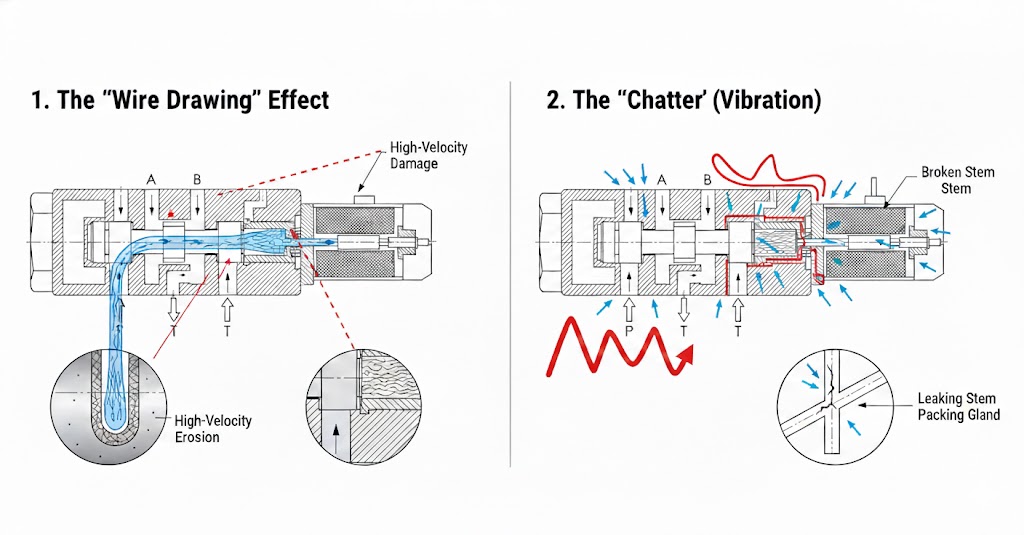
To understand why this is such a bad idea, you need to look at what happens inside the valve when it is partially open.
1. The "Wire Drawing" EffectWhen a gate valve is cracked open (say, 10-20%), the fluid is forced through a tiny, crescent-shaped opening at high velocity.
This high-speed jet acts like a water cutter. It scours the metal surfaces of the gate and the seat. Over time, this erosion cuts deep channels into the sealing surfaces. This damage is called "Wire Drawing" because the cuts look like marks left by a wire. Once wire drawing occurs, the valve will never seal tightly again.
Gate valves are designed to be held firmly in place only when fully closed (by the seat) or fully open (by the bonnet). In a partially open position, the gate hangs loosely in the flow stream like a flag in a hurricane.
The turbulent fluid slams the gate against the valve body guides repeatedly. This is called "Chatter," and it can snap the valve stem, destroy internal guides, or cause the packing gland to leak.
3. Poor Flow ControlEven if you didn't care about damaging the valve, gate valves are terrible at regulating flow. They have a "Quick-Opening" characteristic where the first 20% of opening releases about 90% of the flow, making precise adjustment impossible.
What Should You Use Instead? (The Alternatives)
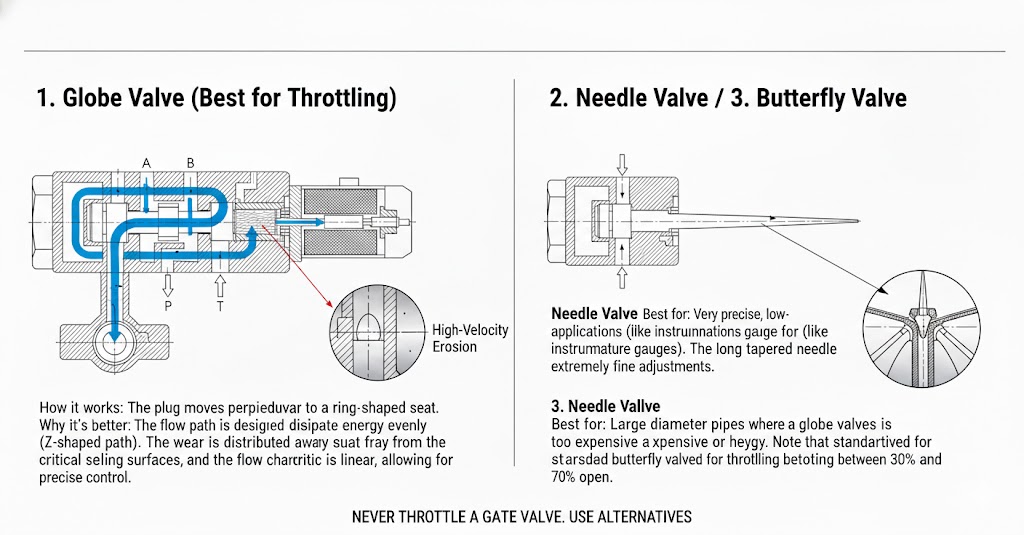
If your system requires flow regulation, replace the gate valve with one of these designs:
1. Globe Valve (Best for Throttling)How it works: The plug moves perpendicular to a ring-shaped seat.
Why it's better: The flow path is designed to dissipate energy evenly (Z-shaped path). The wear is distributed away from the critical sealing surfaces, and the flow characteristic is linear, allowing for precise control.
2. Needle ValveBest for: Very precise, low-flow applications (like instrumentation or pressure gauges). The long, tapered needle allows for extremely fine adjustments.
3. Butterfly ValveBest for: Large diameter pipes where a globe valve is too expensive or heavy. Note that standard butterfly valves are best used for throttling between 30% and 70% open.
Comparison Table: Gate vs. Globe Valve
| Feature | Gate Valve | Globe Valve |
|---|---|---|
| Primary Function | Isolation (On/Off) | Throttling (Flow Control) |
| Flow Resistance | Very Low (Full Bore) | High (Tortuous Path) |
| Throttling Ability | Poor (Damages Valve) | Excellent |
| Sealing Mechanism | Metal-to-Metal Wedge | Plug into Seat |
| Fluid Direction | Straight Through | Changes Direction (S-Shape) |
Summary
- Gate Valve = Stop Valve. Use it only to fully stop or fully start flow.
- Globe Valve = Control Valve. Use it to adjust pressure or flow rate.
If you find a gate valve that is leaking or won't hold pressure, check if operators have been using it to throttle the line. Replacing the valve won't fix the root cause—you need to install a bypass line with a proper Globe Valve for regulation.